
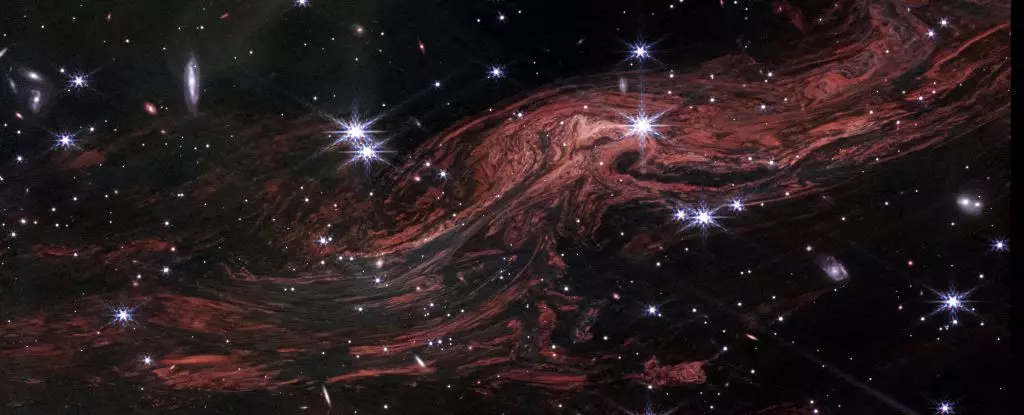
The cosmos is an intricate tapestry woven with myriad elements, including the often-overlooked interstellar dust that plays a pivotal role in the formation of stars and galaxies. Recent revelations from the James Webb Space Telescope (JWST) have brought this cosmic dust into sharp focus, providing unprecedented insights into its complexities. By capturing detailed images of the interstellar medium near the remnants of the star Cassiopeia A—a supernova observed on Earth back in the late 17th century—JWST allows astronomers to investigate a phenomenon previously shrouded in mystery.
As light from Cassiopeia A radiated through space over the last few centuries, it not only illuminated but also interacted with surrounding dust, warming it and manifesting a soft reddish glow that signifies an entirely new realm of beauty beyond our Earthly experience. The dust, primarily composed of small particles characterized by fascinating whorls and striations, has been difficult to analyze in previous observations. However, JWST’s capability to observe in the infrared spectrum has successfully unlocked the mysteries of this space dust, giving scientists an unparalleled view into its intricate structure.
Perhaps one of the most groundbreaking aspects of JWST’s observations is its ability to witness dynamic changes within the interstellar medium on remarkably short timescales. This remarkable capability was demonstrated when the telescope captured images of a specific wisp in the dust cloud surrounding Cassiopeia A over just a few days in late summer 2024. The resulting data revealed a stunning occurrence known as a light echo—an astrophysical phenomenon where light reflects off intervening dust clouds, creating time-displaced echoes of the original light source.
As astronomer Josh Peek from the Space Telescope Science Institute explains, this method of observing “layers like an onion” allows researchers to comprehend the internal structure of dusty regions, which was previously obscured. Light echoes are akin to the waves created when a stone is thrown into a lake; however, in this instance, the ripples each correspond to different interactions with cosmic material, showcasing how light can illuminate the depths of previously unseen interstellar features.
The significance of exploring light echoes extends beyond mere aesthetic observations; they serve as vital tools for mapping the universe and comprehending its contents. Historically, the majority of identified light echoes have arisen from intense celestial events such as the eruption of the extraordinary star V838 Monocerotis. These echoes, typically originating from sources marked by high brightness or dense surrounding dust, have provided glimpses into the characteristics of interstellar environments. However, the thin, delicate dust filaments further from the explosion have eluded detailed scrutiny—until now.
With JWST’s advanced capabilities, researchers turned their attention to uncharted territory by investigating light echoes from faint dust near the Cassiopeia A explosion. While the previous Spitzer space telescope identified this wisp as an echo, its resolution was insufficient to reveal the true nature of the material. To everyone’s astonishment, the clarity of JWST’s images has unveiled complexities and arrangements within the dust that mirror organic structures, illustrating sheets of densely gathered material woven with cosmic knots and whirls.
Among the most surprising findings is the suggestion that the arrangement of interstellar dust may correlate to underlying magnetic field lines traversing the universe. The possibility that magnetized turbulence drives the evolution of these light echoes opens new avenues for scientific inquiry. Armin Rest, also from the Space Telescope Science Institute, likens the observational processes undertaken via JWST to a medical CT scan, emphasizing the precision and depth of three-dimensional analysis now available to astronomers.
This three-fold approach enables the observation of dynamic changes over time, significantly altering how scientists comprehend the interstellar medium. Unlike previous methods that captured snapshots, the JWST allows astronomers to piece together a more comprehensive and intricate narrative regarding the evolution and structure of interstellar dust.
As exploration continues, the findings presented at the recent American Astronomical Society meeting signal the beginning of an exciting era in astrophysics. The combination of groundbreaking technology and innovative methodologies signals a renaissance in our understanding of the universe. Analysts anticipate more comprehensive studies will soon emerge from JWST’s observations, contributing to the broadening of our cosmic knowledge.
The JWST not only illuminates the elegance of celestial phenomena but defines a new paradigm in which we can effectively map and study the complexities of interstellar dust. In doing so, we are reminded that even the faintest cosmic whispers speak volumes about the universe’s history and mechanisms, celebrating the intricate beauty of existence on a grand scale.