
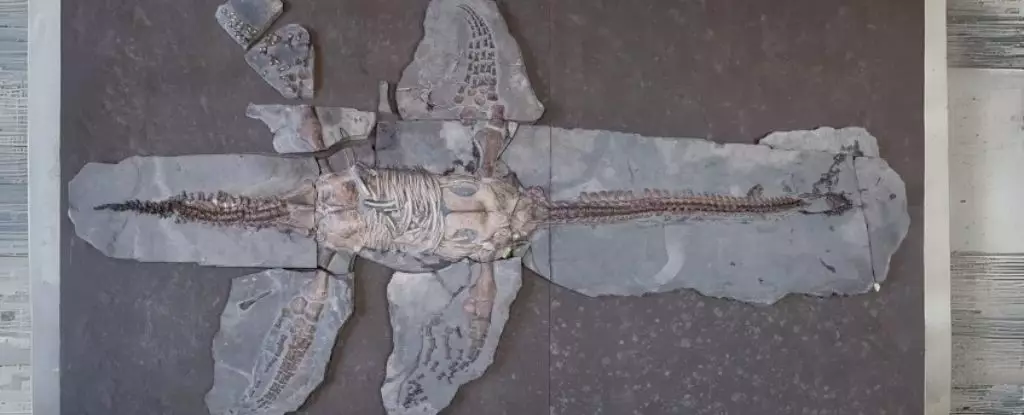
During the Jurassic period, millions of years ago, a remarkable class of marine reptiles called plesiosaurs dominated the ancient oceans. Distinguished by their long necks and four flippers, these creatures were highly adapted for an aquatic lifestyle and became some of the most successful predators of their time. Recent paleontological findings have shed light on their biological characteristics and ecological roles, particularly through the examination of an exceptionally well-preserved fossil known as MH 7. This new understanding reveals not only the physical traits of plesiosaurs but also their possible evolutionary adaptations that echo through time.
Excavated from Holzmaden, Germany, in the 1940s, the MH 7 fossil dates back approximately 183 million years to the Jurassic era, when plesiosaurs thrived. This fossil, measuring about 4.5 meters in length, has undergone extensive analysis by a team of researchers led by Miguel Marx from Lund University. By utilizing advanced techniques such as microscopy and spectroscopy, the team has gleaned significant insights into the morphology of this ancient predator. The study of such fossils is crucial, as only a limited number of plesiosaur soft tissue remains have been identified globally, making MH 7 a significantly unique specimen.
One of the most striking revelations from the MH 7 analysis is the presence of flipper scales, which bear a resemblance to the scutes found in modern sea turtles. The researchers found that while the skin on the plesiosaur’s tail was smooth—similar to that of present-day warm-blooded marine reptiles—the fore flippers exhibited unique small triangular patterns. This structural variation may indicate different functional roles for these body parts. The similarity between plesiosaur flipper scales and the hard, protective coverings found in turtles suggests a convergent evolutionary path driven by similar hydrodynamic challenges in marine environments.
The study further posits that these scales may have served important ecological functions. One hypothesis suggests that the scales provided the necessary traction for plesiosaurs as they grazed along the ocean floor, where they primarily fed on bottom-dwelling organisms such as snails and crustaceans. The evidence gathered from preserved gastric contents strengthens this idea, showing a diet composed of various substrates. This aspect of their feeding behavior is an essential revelation that informs scientists about the ecological niches plesiosaurs occupied, painting a vivid picture of their interactions within the marine ecosystem.
Moreover, the evolution of the plesiosaur’s skin detail presents a captivating contrast to other marine reptiles of the era. Unlike ichthyosaurs, which evolved to lose their scales to reduce drag, plesiosaurs retained their reptilian scales even as they transitioned into an aquatic niche. This retention may have conferred evolutionary advantages, suggesting that the plesiosaur lineage was influenced by specific selective pressures that facilitated a unique form of survival. The findings indicate that the adaptations seen in MH 7 reflect broader evolutionary trends, illustrating how marine life developed specialized features to thrive in diverse ecological conditions.
The exploration of the MH 7 plesiosaur fossil has substantially advanced our understanding of these ancient marine reptiles. By uncovering details about their physical characteristics and ecological roles, researchers have begun to construct a more comprehensive image of how plesiosaurs navigated the challenges of their environment. As analysis continues, such fossils will undoubtedly reveal even more about the interconnected web of life in prehistoric oceans, further highlighting the importance of paleontological research in uncovering the secrets of evolution. The ongoing study of these fascinating creatures not only deepens our understanding of their biology but also underscores the intricate tapestry of life that has existed long before humans.