
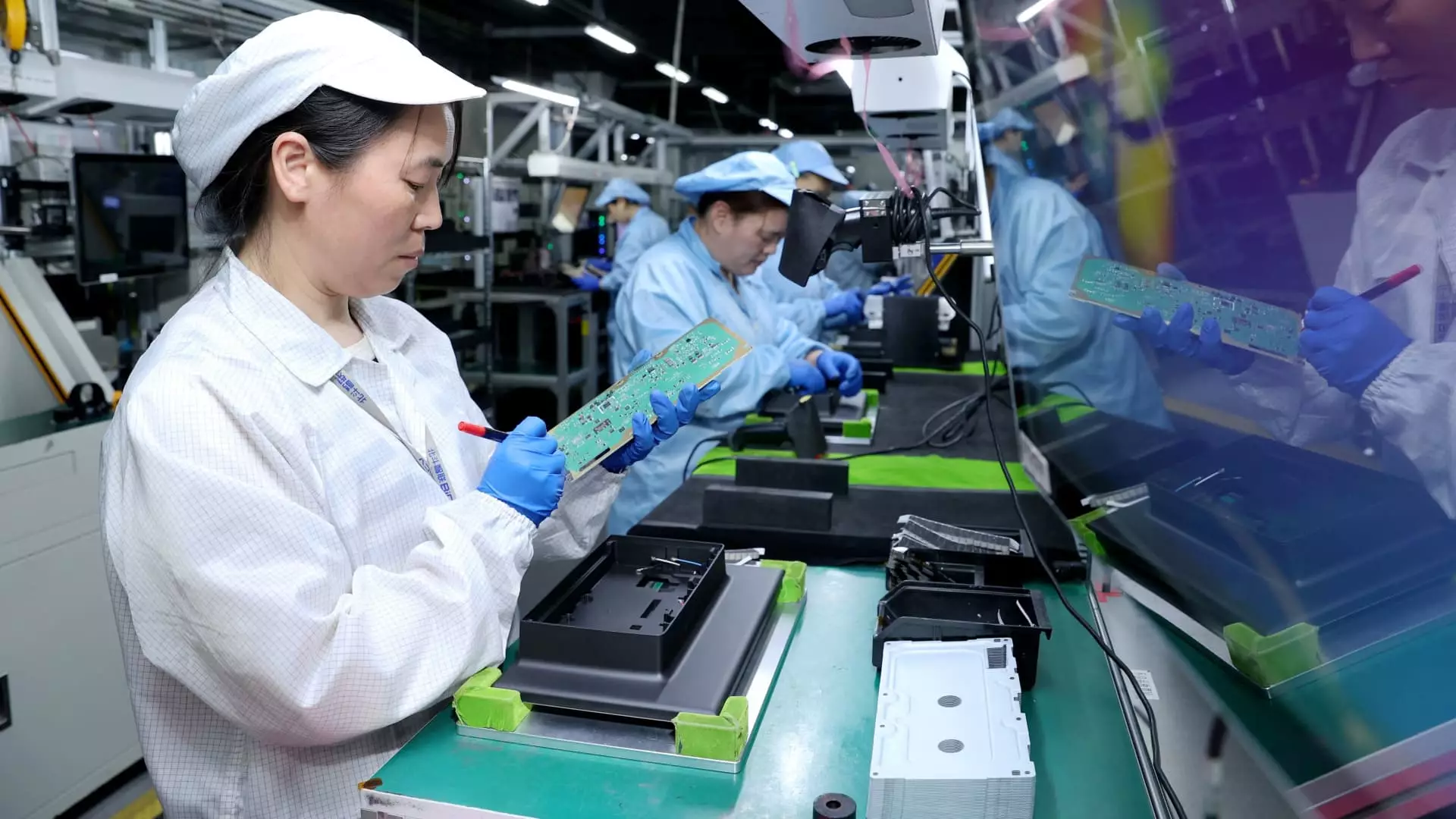
China’s recent report indicating a resurgence in industrial profits has been met with cautious optimism. Official figures revealed that in the first quarter, cumulative profits for industrial firms rose 0.8% year-over-year, totaling a staggering 1.5 trillion yuan (approximately $206 billion). This interrupted a previous downward trend, allowing analysts to momentarily celebrate the light at the end of a long, tumultuous tunnel characterized by declining corporate profits. However, the shadows of a persistent trade war with the United States loom large, and any semblance of stability appears precarious at best.
Despite this apparent growth, one cannot ignore the alarming backdrop against which this data unfolds. Profits for March alone saw an increase of 2.6%, a noteworthy uptick after a disheartening 3.3% drop in the preceding year. Yet, investors remain skeptical as the U.S. has aggressively imposed tariffs, heightening trade tensions that directly impact China’s export-driven economy.
In essence, the numbers provide an illusion of health, masking the underlying turbulence that threatens to disrupt not only the growth of industrial profits but also the probability of sustained economic recovery for a country that needs it desperately.
The Government’s Evolving Role in Economic Support
In response to these bleak economic realities, the Chinese government finds itself at a crossroads. The ruling Communist Party’s Politburo recently highlighted its intent to bolster support for sectors most affected by U.S. tariffs. Initiatives aimed at fostering local consumption and innovation are being discussed, as is the establishment of new monetary tools to enhance policy financing for troubled industries. Yet, one must question whether such measures will genuinely catalyze a turnaround or simply serve to placate those clamoring for immediate relief.
The impetus to pivot from a reliance on the U.S. market should be viewed critically. Beijing’s appeals to turn to local buyers as an alternative may offer a temporary solution, yet they fundamentally fail to address the sluggish domestic demand that is plaguing many factories across China. This leaves businesses caught in a paradox—encouraged to innovate and find local solutions while battling price wars and dwindling consumer confidence at home.
Moreover, the deeper implications of a shrinking export market cannot be overlooked. As China struggles with rising trade disruptions, there is a poignant irony in the government’s push for self-sufficiency. The call for innovation, while noble, may not be sufficient to overcome the significant barriers presented by both domestic and international economic pressure.
Sectored Analysis of Profit Responsiveness
Looking deeper into the data reveals keen insights; specific sectors are demonstrating remarkable resilience while others falter. Notably, the wearable smart device manufacturing sector reported a staggering profit increase of 78.8%, buoyed by a consumer goods trade-in campaign. In contrast, state-owned enterprises saw profits decline by 1.4%, while private firms suffered a minuscule 0.3% drop. Interestingly, foreign firms managed a 2.8% gain, evoking thoughts on operational agility and market adaptability that may elude their counterparts in the public sphere.
This sectoral divergence raises critical questions about the survival of traditional industries versus those willing to innovate in response to market demands. Are the gains of the tech-savvy sectors sustainable, or are they merely a brief respite in the looming storm? Alternatively, can state-owned enterprises recalibrate and revolutionize their operations to compete in an increasingly dynamic marketplace?
The Broader Economic Landscape: Navigating Uncertainty
In navigating the complexities of the modern economy, one cannot downplay the external pressures building on China’s industrial base. Analysts have warned that the time for reactive measures may be drawing to a close; a more proactive strategy is necessary. As deflationary pressures continue to rear their ugly heads, impacting corporate profitability and the disposable income of the skilled workforce, the path to economic recovery appears fraught with challenges.
Current trends suggest that the external environment is becoming markedly more convoluted. With increasing uncertainty and instability, economic forecasts seem marred by caution. As firms engage in a delicate dance of adaptation to policy changes and market conditions, the emphasis should be placed on innovation and diversification—both of which are paramount for resilience in the current economic climate.
Given this complexity, it’s critical for observers to remain vigilant, examining the nuanced layers of growth juxtaposed with pressing challenges. While some numbers may indicate progress, the heart of the matter rests in how well China can navigate the impending repercussions of a prolonged trade conflict and foster a robust internal economy. Far from emerging unscathed, the intricate interplay of global economics and domestic policies will ultimately determine China’s trajectory in these tumultuous times.