
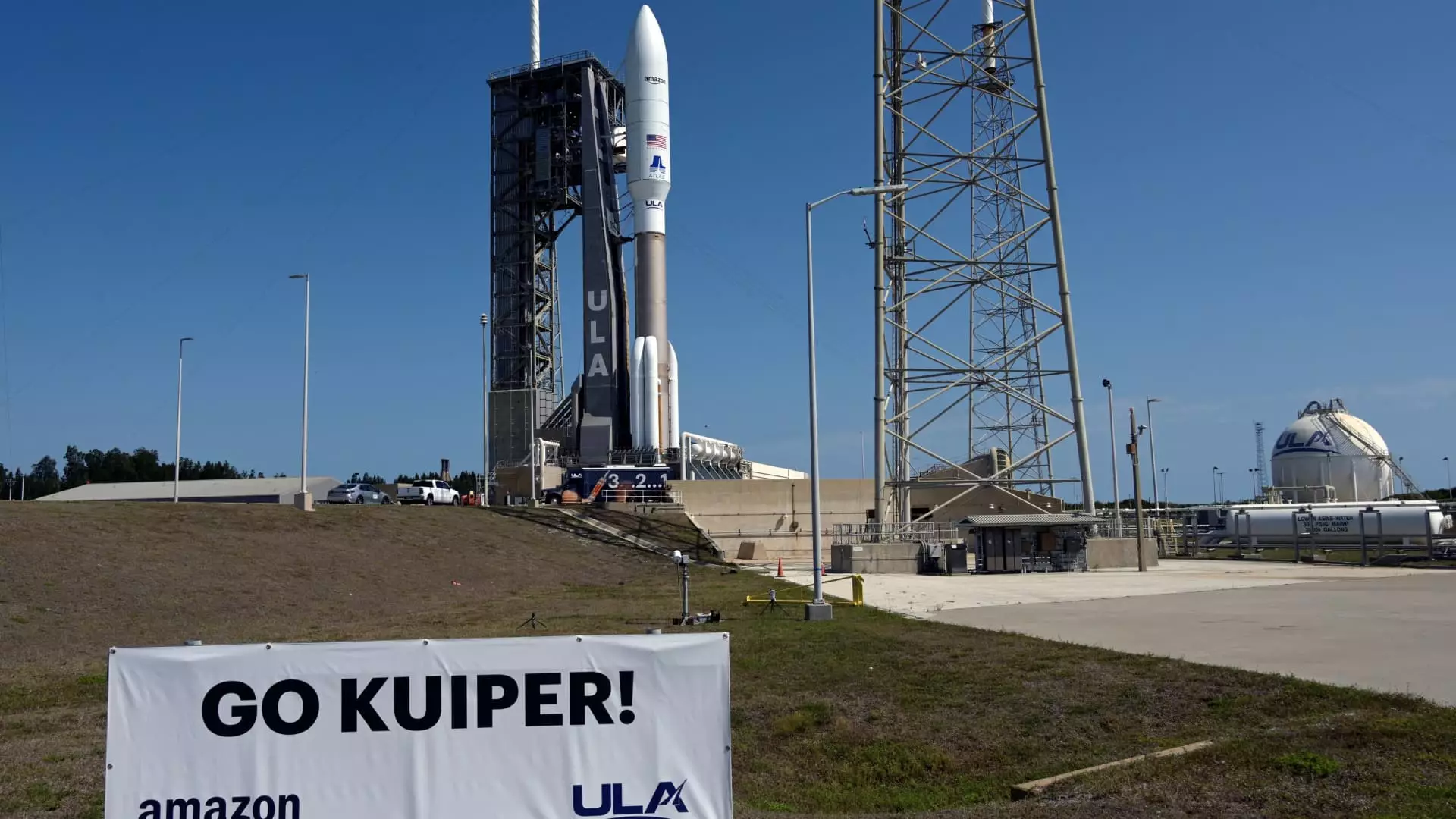
The thrilling spectacle of a satellite launch is an event that captures the imagination. However, the recent setback experienced by United Launch Alliance (ULA) serves as a sobering reminder of the fragilities and complexities inherent in modern space exploration. On a day fraught with anticipation, ULA was met with disappointment as it had to delay the launch of a new batch of Amazon’s Project Kuiper internet satellites. Just 30 minutes before ignition, they reported an elevated purge temperature in the Atlas V rocket’s booster engine, forcing them to scrub the launch entirely. This unfortunate incident epitomizes the unpredictable nature of a field that, despite its technological advancements, remains at the mercy of mechanical intricacies.
The Implications of Delay and Innovation
A delay in launching satellites is not merely a corporate inconvenience; it has broader implications for the advancement of internet technology. Amazon’s Project Kuiper competes in a rapidly saturating market dominated by SpaceX’s Starlink. This makes every missed deadline potentially costly, not only to Amazon but to the consumers reliant on improved internet service. Amazon’s ambition is massive, targeting a constellation of over 3,000 satellites to provide widespread internet access. The directive is clear: by July 2026, half of this constellation must be operational, a deadline imposed by the Federal Communications Commission. The pressure on Amazon and ULA mounts when delays occur, underscoring the importance of precision and reliability in a system where any hiccup can set back years of progress.
Technology’s Double-Edged Sword
As exciting as advancements in satellite technology are, they come with a concomitant risk. ULA’s experience illustrates how vulnerabilities still exist, even in the most meticulously designed systems. Tory Bruno, ULA’s CEO, emphasized the need to address the technical struggles while reassuring stakeholders that plans to improve and rectify the issue are in motion. Despite the assurance, the urgency of delivering satellite-based internet in an era that increasingly relies on digital connectivity can overshadow the challenges these companies face. Such incidents remind us that, while innovation can revolutionize our lives, it is also a labor of frailty.
The Competitive Arena and High Stakes
The competitive landscape of space-based internet services can be merciless. With Elon Musk’s SpaceX leading the charge, companies like Amazon must not only match bold technological feats but also navigate the intricacies of regulatory compliance and public expectations. The marketplace exhibits a dualism of burgeoning possibilities juxtaposed with the harsh realities of operational hurdles. Delay after delay could not only hinder Amazon’s ambitious plans, but it could also allow competitors to seize the advantage, perpetuating a cycle of haste and error in an industry desperately needing consistency.
A Call for Pragmatism in Space Exploration
While the allure of space is captivating and each launch promises a new frontier of potential, it is crucial to approach these ambitious programs with a realistic understanding of the associated risks. Corporate aspirations should be grounded in humility and transparency. Investments in technology must also prioritize reliability over speed, lest we find ourselves orbiting indefinitely around failure and unmet promises. The excitement surrounding space ventures must be tempered with an appreciation for the unpredictability of engineering marvels. As we look up to the stars, we should remain aware that the journey is as perilous as it is inspiring.