
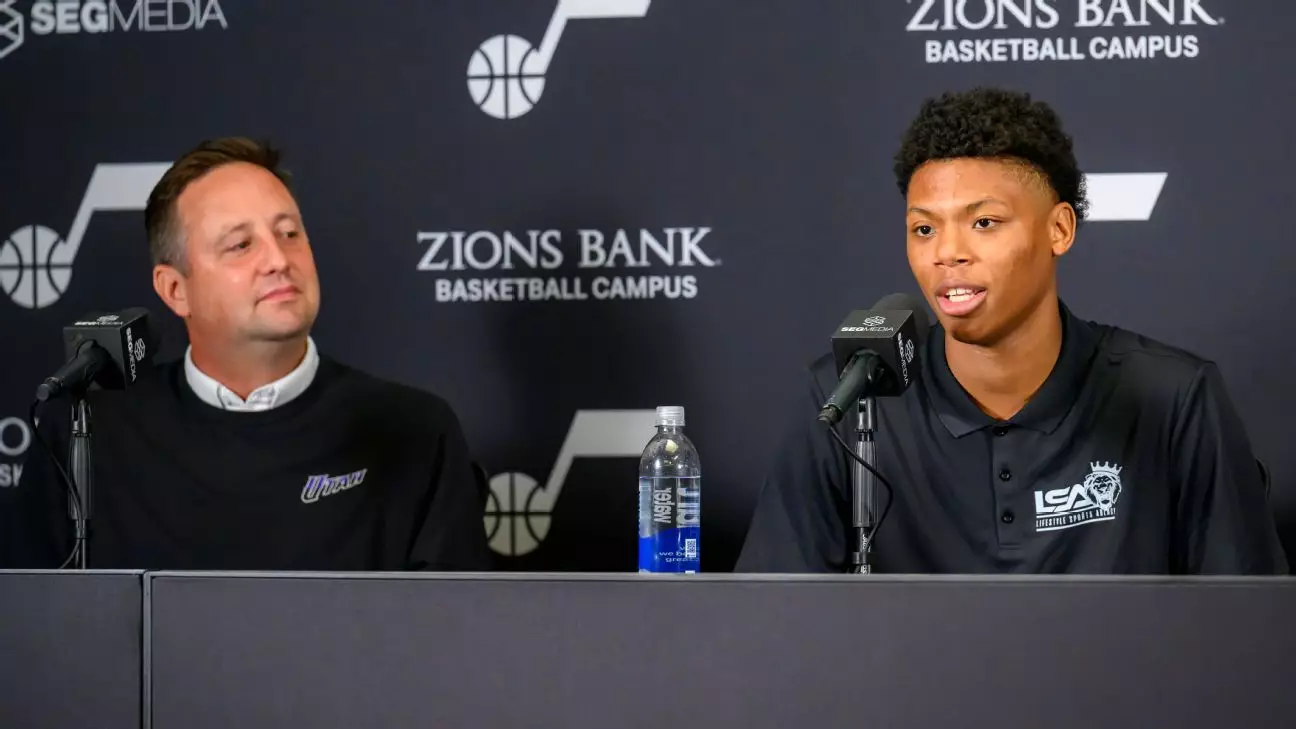
Ace Bailey’s drafting by the Utah Jazz at No. 5 was widely viewed as a surprise, even a risky decision, given the forward’s unconventional pre-draft process and mixed evaluations. The Jazz took a chance on a player who openly turned down workouts with interested teams and whose preferred landing spots did not include Salt Lake City. Yet, Bailey’s immediate reaction was not defiance or disappointment but gratitude and enthusiasm about joining the Jazz. This attitude, though somewhat rare among recent lottery picks, reveals a maturity that the organization likely values as much as his on-court skills.
Bailey’s draft slide from a projected top-three pick to No. 5 underscores a puzzling dissonance between talent and perception. While mock drafts were bullish on his scoring versatility and physical tools, concerns about his efficiency, defensive intensity, and overall maturity tempered teams’ enthusiasm. Utah’s gamble is not just on Bailey’s physical gifts but on his potential growth into a more balanced, impactful NBA player. From a center-left liberal perspective, this embodies a philosophy of investment in personal development rather than mere instant gratification—a model that rewards character and work ethic alongside raw talent.
Rejecting the Conventional Pre-Draft Grind
Bailey’s refusal to engage with multiple teams’ workout invitations represents a bold deviation from the established pre-draft protocol. Many prospects bend over backward to demonstrate willingness and availability, fearing that missing workouts diminishes their draft value. Bailey, conversely, prioritized selectivity and personal comfort, signaling a deep self-confidence or perhaps a strategic miscalculation. Given the standard narrative of hustle and grit, some critics quickly labeled him as difficult or uncommitted.
However, this situation invites a more nuanced discussion. In a professional environment often criticized for exploitative practices and pressure, Bailey’s approach can be seen as an assertion of agency and boundary-setting. From a moderate liberal standpoint, this challenges the league’s sometimes transactional, dehumanizing draft machinery. His insistence on choosing where and how to be evaluated, while risky, highlights the importance of mental health and personal sovereignty in professional sports.
Utah’s Vision: Versatility and Character
Utah’s front office, under Austin Ainge, clearly prioritized more than just scoring numbers. The Jazz targeted players with not only high potential but also “high character,” aiming to build a culture grounded in resilience and multidimensional skills. Bailey joins fellow rookies Walter Clayton Jr. and John Tonje, both recognized for their scoring aptitude but also their defensive capabilities.
This multidimensional emphasis is crucial in today’s NBA, which demands adaptability and two-way play. While Bailey’s offensive skill set—shooting off the dribble, step-back jumpers, attacking the paint—was his calling card at Rutgers, Utah acknowledges his need to mature defensively and improve his basketball IQ. Such an organizational stance avoids the shortsightedness of chasing flashy scoring alone and reflects a commitment to sustainable team development and collective success.
Beyond Stats: The Human Factor in Bailey’s Development
Numbers tell only a fraction of Bailey’s story. Averages like 17.6 points and 7.2 rebounds per game at Rutgers demonstrate strong base capabilities, but his true challenge lies in translating these skills within a more demanding and scrutinized NBA environment. His own acknowledgment of imperfections and ongoing work signals a grounded mindset that is often overlooked in traditional draft narratives.
It is refreshing to hear a young athlete candidly admit that “everybody makes mistakes” and affirm the importance of continuous effort. This humility and resilience are arguably as vital as raw talent in professional growth, especially in a league where external pressures can quickly destabilize fragile confidence. Bailey’s readiness to embrace this journey, despite the initial draft day uncertainties, underscores a wider lesson: potential is dynamic and evolves through perseverance and adaptability.
A Quiet Revolution in Player Empowerment
Bailey’s pre-draft choices and Utah’s confidence in him represent a subtle but meaningful shift in player-team dynamics. Where past drafts often emphasized blind compliance and uniformity, this case highlights a more dialogic and nuanced relationship. It reflects a center-left belief in empowering individuals while fostering institutional frameworks that promote growth and accountability.
In this sense, Utah’s approach challenges the transactional coldness often characterizing professional sports. Investing in character, supporting diverse paths, and recognizing player agency could set a precedent for future drafts and organizational philosophies—one where human complexity is embraced rather than ignored. Ace Bailey’s journey, still in its early chapters, might well become a blueprint for balancing talent, integrity, and authenticity in the modern NBA landscape.