
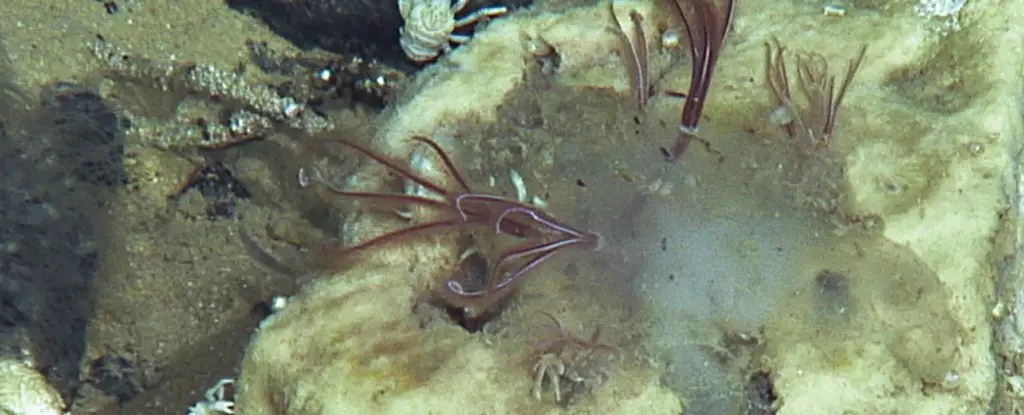
The discovery of ancient bone-eating worms challenges our understanding of evolutionary adaptability and resilience. These creatures, often dismissed as mere curiosities, are revealing themselves to be part of a centuries-long saga of survival and specialization. Unlike most marine organisms that rely on simpler diets such as plankton or decayed organic matter, bone-eaters have carved out an aggressive and highly successful ecological niche. Their existence across at least 100 million years suggests a tenacious ability to exploit resources overlooked by most other species—a testament to evolution’s capacity for innovation in the face of relentless competition and changing environmental conditions.
The fascinating revelation that these worms date back to the Cretaceous period merely intensifies the intrigue. During that era, Earth’s oceans teemed with massive marine reptiles such as mosasaurs and ichthyosaurs, yet the bones of these ancient giants became a staple diet for these tiny but formidable worms. This indicates a level of ecological opportunism that is both inspiring and somewhat disturbing; it shows that within the vast microbial tapestry of the sea, some life forms thrive by feeding on what others leave behind, often after death, in ways that starkly contrast human ideals of reverence for life and its preservation.
Evolutionary Stability and the Power of Trace Evidence
What sets these worms apart from other deep-sea inhabitants is their remarkable evolutionary stability. The research indicates that certain burrow patterns seen in the fossils are strikingly similar to those made by the modern species of Osedax. This suggests that once this ecological role was established, it endured for millions of years without significant change—a phenomenon that defies the often chaotic nature of evolution, which favors adaptation and diversification in response to environmental shifts.
Using advanced imaging techniques such as CT scanning, scientists have uncovered subtle traces in the fossils—delicate burrows and microscopic fragments—that serve as silent testimonies to ancient feeding behaviors. These traces are essentially the skeletons of a long-lost interaction between predator and prey, preserved in stone rather than in the soft tissue remains typical of other fossil evidence. This reliance on trace fossils highlights both the limitations and the potential of paleontological science. It underscores the importance of indirect evidence in reconstructing prehistoric life and reminds us that what we often discard as insignificant might hold the key to understanding ancient ecosystems.
The discovery that these worms appeared much earlier than previously believed forces us to reconsider the timeline of complex ecological relationships. It implies that the evolution of specialized feeding strategies, such as bone consumption, may have begun in response to niches created by the rise and fall of long-extinct megafauna and reptiles. The persistence of these worms attests to a kind of evolutionary ingenuity that refuses to be eradicated by extinction events or environmental upheavals.
The Implications for Modern Marine Ecology and Humanity’s Role
While these ancient revelations are captivating in their own right, the modern implications are equally compelling. Today’s bone-eating worms continue to play a role in oceanic nutrient cycling, a process that is critically underrated in the context of global ecological health. Their presence exemplifies how life persists in the most unlikely environments and how ecosystems are resilient and complex beyond superficial observation.
However, in an era increasingly dominated by human activity, the survival of these creatures warrants a cautious reflection on our influence on marine ecosystems. The destruction of whale populations and other marine life through overfishing, pollution, and climate change is disrupting the natural processes that sustain these worms and their ecological counterparts. Our stewardship—or lack thereof—could inadvertently wipe out this ancient lineage before we fully comprehend its significance.
Furthermore, the genetic and biological studies of modern Osedax species could unlock secrets about resilience that are invaluable in developing conservation strategies for threatened marine species. Understanding how these worms adapt, survive, and even thrive under extreme conditions might inspire biomimetic solutions to human challenges, from waste management to resource recycling.
It’s alarming that such specialized and ancient creatures remain relatively obscure in popular consciousness. Their long-standing existence underscores a broader truth: life finds a way, often in forms we find unsettling or unexpected. Recognizing the importance of these tiny, bone-consuming worms may challenge our perceptions of ecological health, resilience, and the delicate balance of life beneath the surface of our oceans.