
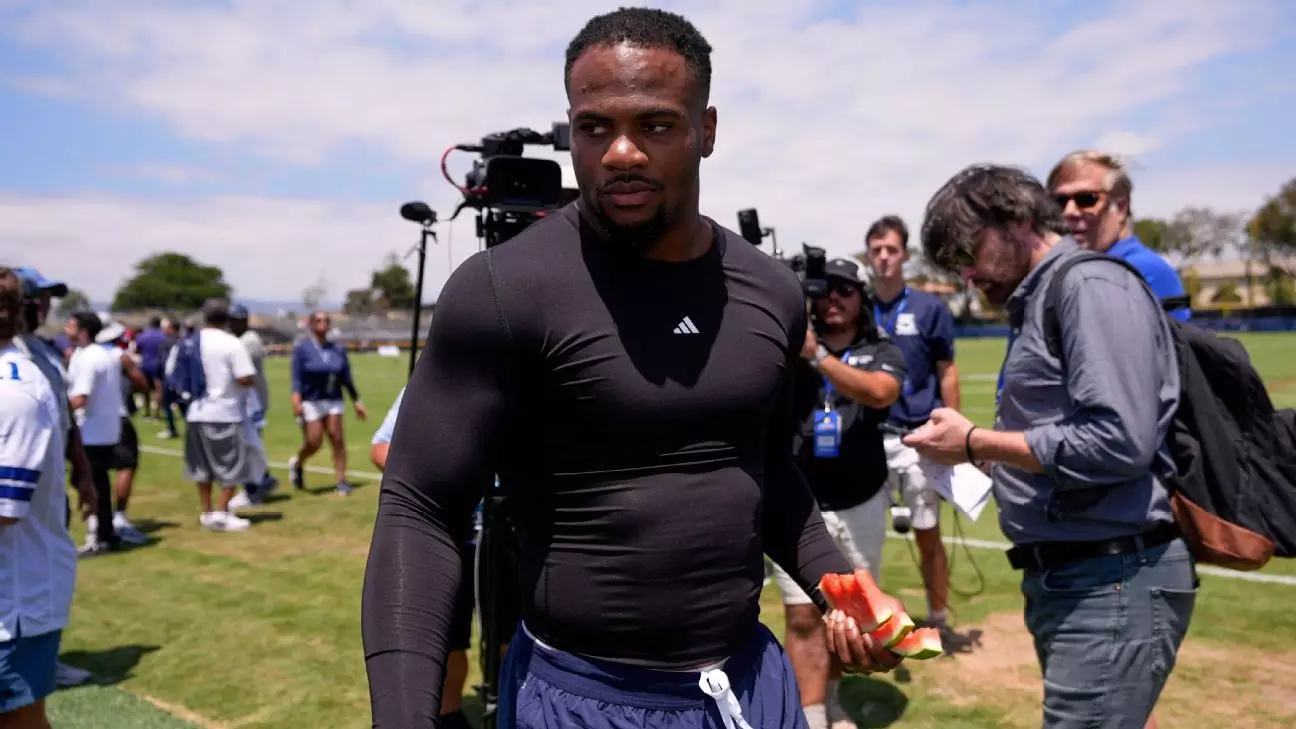
In the high-stakes world of professional football, where every moment on the field is scrutinized and every decision can make or break a season, the Dallas Cowboys find themselves ensnared in a paradox. On the surface, Coach Brian Schottenheimer exudes confidence regarding Micah Parsons’s readiness for the upcoming season opener against the Philadelphia Eagles. Yet, beneath this veneer of assurance lies a tangled web of uncertainties—an unresolved contract extension and an injury that could jeopardize Parsons’s availability. This dichotomy reveals a troubling trend in modern sports: the superficial display of certainty to mask deeper vulnerabilities that threaten team stability and player welfare.
Despite the gaps in contract negotiations, the Cowboys maintain that Parsons will be on the field come opening day. Such statements, however, must be viewed through a skeptical lens. They evoke the old sports adage—”all talk, no action”—especially given that no formal discussions on a new deal have occurred since March. The quarterback of these negotiations, Parsons’s agent, remains silent, leaving fans and analysts to speculate whether the Cowboys’s proclaimed confidence is rooted in genuine trust or merely strategic rhetoric meant to rally support and avoid public fallout. In reality, this ongoing contract stalemate exposes the fragile assumptions underpinning team management and the often-overlooked human element—an athlete’s health, morale, and sense of security.
The Myth of Controlled Preparedness
Coach Schottenheimer’s assurances about Parsons’s physical readiness also warrant skepticism. His comments about Parsons’s participation in walkthroughs and meetings, despite his absence from on-field practices, underscore a dangerous misconception—that mental engagement and limited physical activity suffice in replacing full-capacity training. Such an approach neglects the intricate and unpredictable nature of injuries, particularly soft-tissue issues like back tightness, which can easily escalate if overtaxed. It underscores a flawed belief in the ability to control injury trajectories through permissioned participation, when in truth, the athlete’s body often betrays these safeguards.
This situation illuminates a broader issue within elite sports: a tendency to prioritize short-term appearances over long-term health. When a star player like Parsons is kept on the sidelines, even in walkthroughs and meetings, it signals an underlying insecurity—one rooted in the fear of further injury or insufficient preparation. The emphasis on physical readiness as the only metric of fitness neglects the psychological resilience required to perform consistently at the highest level. The Cowboys’s reliance on their medical and training staff, while important, fails to address the core issue: the athlete’s autonomy and the risk of coercive recovery schedules that could lead to greater harm down the line.
The Illusion of Control in a Chaotic Environment
Ultimately, the Cowboys’s narrative reflects a disturbing trend in professional sports: the desire to project control amidst chaos. Drafting players, negotiating contracts, managing injuries—all these elements are inherently unpredictable. Yet, the franchise’s statements aim to foster confidence, both internally and publicly. This creates a veneer of certainty that may not align with reality.
The team’s decision-making in the coming days, especially regarding Parsons’s role in the roster and their strategic choices in practice sessions, underscores how much is at stake. The need to finalize a 53-man roster by Tuesday and the potential for keeping an extra pass rusher showcase the delicate balancing act between risk and reward. Parsons’s health, contract situation, and on-field readiness form a complex triad that influences roster decisions, often at the expense of transparency.
Moreover, this situation exposes a broader philosophical issue within center-wing liberalism—a recognition that systemic structures often mask underlying inequalities and uncertainties. Just as the NFL’s sports narratives craft an illusion of control, society at large often portrays a landscape of stability and certainty when, in reality, chaos and vulnerability lurk beneath the surface. The Cowboys’s handling of Parsons exemplifies this phenomenon: a pretense of preparedness and confidence that can evaporate in an instant when unforeseen circumstances arise.
While the Cowboys and Parsons’s management cling to hope and carefully worded assurances, the truth remains. Injury fears, contractual delays, and the unpredictable nature of athletic performance threaten to undermine all these efforts. In this context, the veneer of confidence transforms into a fragile façade, ultimately revealing the precariousness of even the most meticulously crafted plans in the ruthless arena of professional sports.