
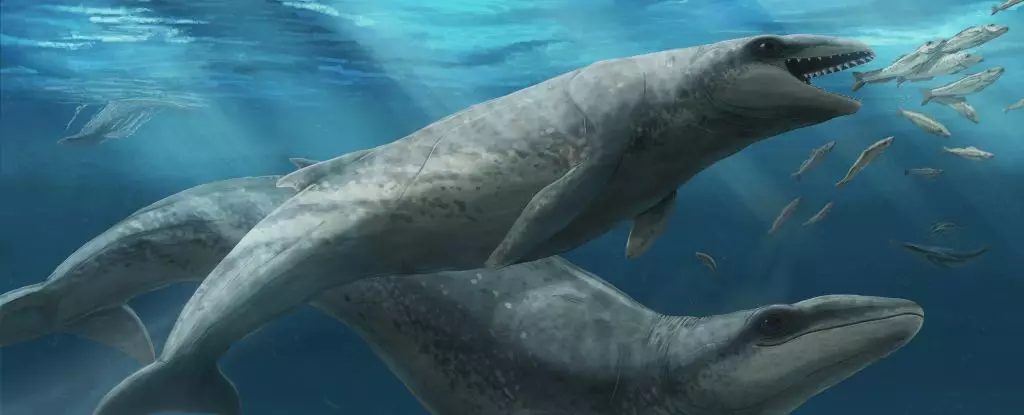
In the world of paleontology, every new fossil reshuffles our understanding of life’s history, yet some discoveries shatter the very foundation of established narratives. The recent unveiling of Janjucetus dullardi—a miniature prehistoric baleen whale—forces us to reevaluate long-held assumptions about marine evolution, size, and ecological dominance. Contrary to the glamorous image of whales as colossal ocean monarchs, this small but fierce creature exemplifies the dynamic and often overlooked complexity of early marine life. Its existence reminds us that size isn’t everything and that evolutionary success often hinges on diverse adaptations that challenge our simplistic notions of progress.
This tiny whale, roughly the size of a human or a penguin, emerges from the fossil record as a striking testament to ecological diversity in prehistoric waters. Its small stature and razor-sharp teeth cast doubt on the rosy perception of whales as gentle giants. Instead, it paints a picture of an ocean teeming with fierce, opportunistic hunters—animals perfectly adapted to survive in competitive environments devoid of the protective advantages of size. This fossil not only broadens our understanding of whale morphology but also underscores how evolution is a relentless dance of change, often favoring traits that seem counterintuitive with current standards.
Questioning the Assumption that Bigger Means Better
The common narrative portrays size as a decisive factor in survival and dominance in the oceanic realm. Larger whales can filter vast amounts of water effortlessly, fend off predators, and travel long distances with ease. Yet, Janjucetus dullardi–a creature that never grew beyond a modest 2 meters–embodies a different evolutionary strategy: agility, sharp teeth, and acute senses. These features suggest that early whales thrived in a competitive landscape where cunning and specialized adaptations often outperformed brute size. This insight is crucial, as it urges us to reconsider our bias towards gigantism as the hallmark of evolutionary success.
Modern whales like the blue whale or the massive sperm whale symbolize pinnacle achievements of size, but the fossil record narrates a story of gradual escalation in body mass, occurring over millions of years. Janjucetus represents a transient stage—a brief but critical chapter—when small, shark-like whales dominated the ecosystem before the evolutionary tide turned towards gigantism. This progression highlights how environmental pressures, prey-predator dynamics, and ecological niches influence morphological transformations over vast time scales. It forces us to question whether our admiration for size clouds the recognition of equally vital evolutionary strategies.
Implications for Conservation and the Human Narrative
Beyond academic fascination, the discovery of Janjucetus dullardi carries profound implications for our current ecological and conservation paradigms. It prompts introspection about the narratives we craft around progress and survival. The tendency to elevate larger species as the ‘ultimate’ survivors echoes human tendencies to valorize power and magnitude—traits often associated with strength and dominance. But nature reminds us through fossils like Janjucetus that resilience and adaptability come in many forms, including the small, cunning, and sometimes overlooked.
In a world grappling with rapid climate change and biodiversity loss, this fossil serves as an unsettling reminder: adaptability, not size or brute strength, may be the key to survival. It hints at the importance of conserving a broad spectrum of species, recognizing that ecological balance often depends on a diversity of strategies—some of which are less visible or traditionally celebrated. Failing to appreciate this diversity risks homogenizing ecosystems, making them more fragile in the face of environmental upheavals.
Furthermore, reconciling our admiration for impressive giants with the recognition of small but pivotal species can foster a more nuanced, ethical approach to conservation. It champions a shift from focusing solely on flagship species to embracing the silent, smaller organisms that played crucial roles in shaping life’s history. Janjucetus dullardi exemplifies that evolution’s grand narrative is rarely about size but about resilience, adaptability, and cunning—a message that resonates profoundly in our contemporary efforts to preserve Earth’s rich biodiversity.