
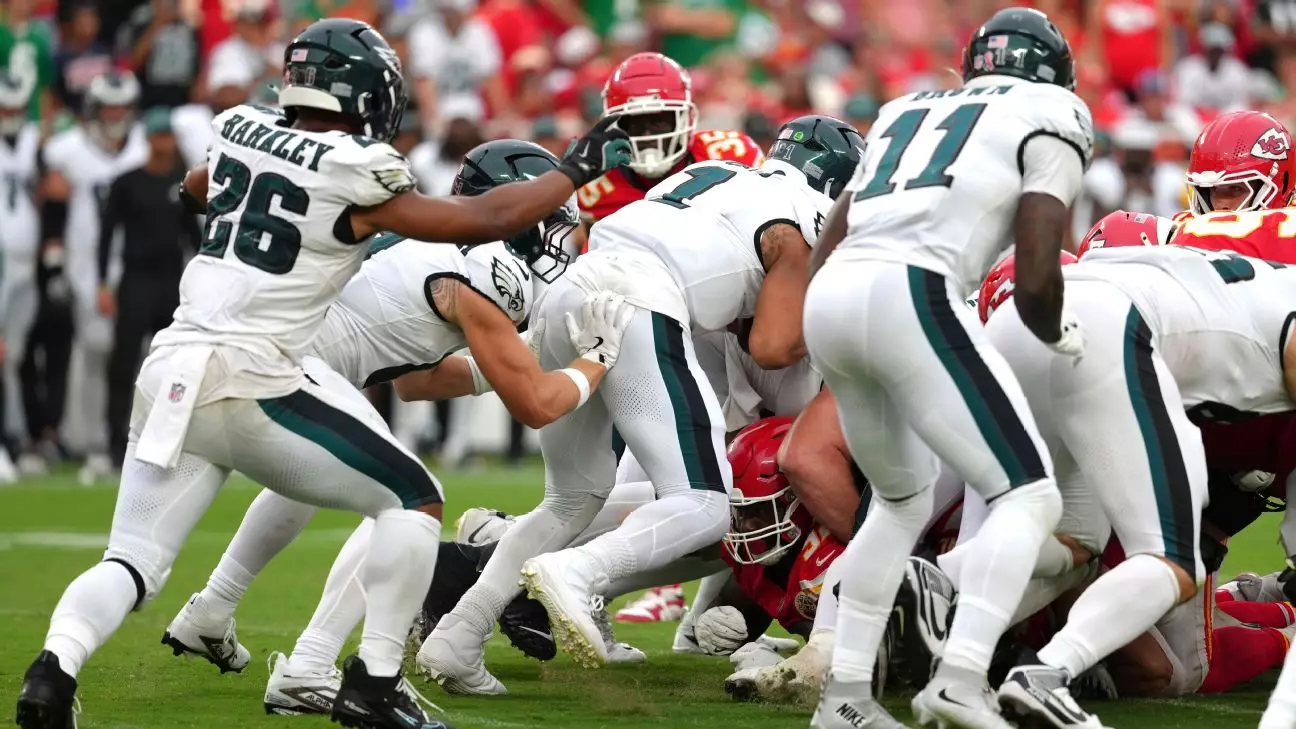
In a sport built on discipline, strategy, and fierce competition, the recent scrutiny of the Philadelphia Eagles’ so-called “tush push” exemplifies a troubling pattern of bias and inconsistency that undermines the integrity of the game. The NFL’s decision to instruct officials to call the play “tight” and to highlight potential infractions—despite its widespread success—raises serious questions about the league’s objectivity and fairness. By singling out the Eagles, the NFL appears to be engaging in a subtle form of favoritism rooted not in safety or fairness, but in protecting its image and preventing any perceived advantage that challenges traditional officiating standards.
The league’s emphasis on tightening the whistle around this specific formation seems less about ensuring a level playing field and more about wielding regulatory pressure against a team that has been incredibly effective in short-yardage situations. Their initial refusal to ban the play altogether, followed by the recent flap over flagged infractions, signals a clear double standard: teams capable of executing this play flawlessly are targeted more aggressively while others are left to operate under a different, perhaps less scrutinized, set of unofficial rules.
Selective Enforcement Exposes Deeper Flaws Within the NFL
When the NFL publicly signals to officials that they should be “tight” on the tush push, it inadvertently exposes the league’s inconsistent enforcement of rules. If the play is inherently legal—evidenced by the Eagles’ remarkable success rate—then penalizing or flagging it unnecessarily not only penalizes a team’s strategic ingenuity but also distorts the game’s fairness. Such regulatory selectivity effectively politicizes officiating, where favoritism and subjective judgment are allowed to distort the outcome.
Furthermore, the league’s attempts to frame the play as borderline complicated to officiate smacks of a defensive stance aimed at avoiding accountability. If the play is so difficult to call, then why impose stricter rules against it? Either the play is legal and fair, or it’s inherently problematic and should be banned. The inconsistency suggests that the problem lies not in the play itself but in the league’s reluctance to accept its success and innovation, fearing it might diminish traditional narratives or challenge established power dynamics within the game.
The Silencing of Innovation and the Veterans’ Role in Shaping Rules
The failed attempt to ban the tush push earlier this year underscores the NFL’s hesitation to embrace strategic evolution. The proposal by the Green Bay Packers was narrowly defeated, yet this resistance reveals a league community that is reluctant to adapt and modernize. It’s an institutionalized conservatism that stifles ingenuity, punishing teams like the Eagles who dare to push the boundaries of conventional play.
Veteran players and offensive linemen, such as Cam Jurgens, voice confusion and frustration, exposing the disconnect between league officials and the realities of modern football. These players understand their craft and recognize the play’s legality. Their perspectives challenge the narrative pushed by league officials and commentators, whose commentary often leans toward sensationalism and bias. This dissonance highlights how the league’s rules and enforcement mechanisms sometimes serve the interests of the establishment rather than the authentic spirit of the game.
Narratives of Fairness Versus Reality of Power Dynamics
At its core, the controversy over the tush push reflects broader societal questions about power, fairness, and institutional control. The NFL positions itself as the sport’s ultimate authority, yet it often appears more focused on maintaining its dominance and protecting traditional structures than on fostering fairness. When referees are instructed to officiate plays “tight,” it suggests an underlying desire to curb innovation rather than uphold the spirit of competition.
From a center-left perspective, this situation calls for a more transparent and fair governance of the sport. The NFL’s actions reveal a tendency to favor established norms over progress, reinforcing elitism and status quo preservation. Punishing innovation under the guise of officiating difficulty is not only an unfair double standard but also a slap in the face to teams and players who strive to adapt and improve the game. Fairness in sport should be rooted in rules that evolve with the game, not in arbitrary officiating that disproportionately affects certain teams.
The lingering question remains: is the league truly committed to fairness, or is it more invested in protecting its traditional power structures? As the NFL attempts to navigate the competitive landscape, wise and impartial leadership should prioritize consistency, transparency, and a genuine openness to change—values that are often sidelined in favor of preserving control and authority.