
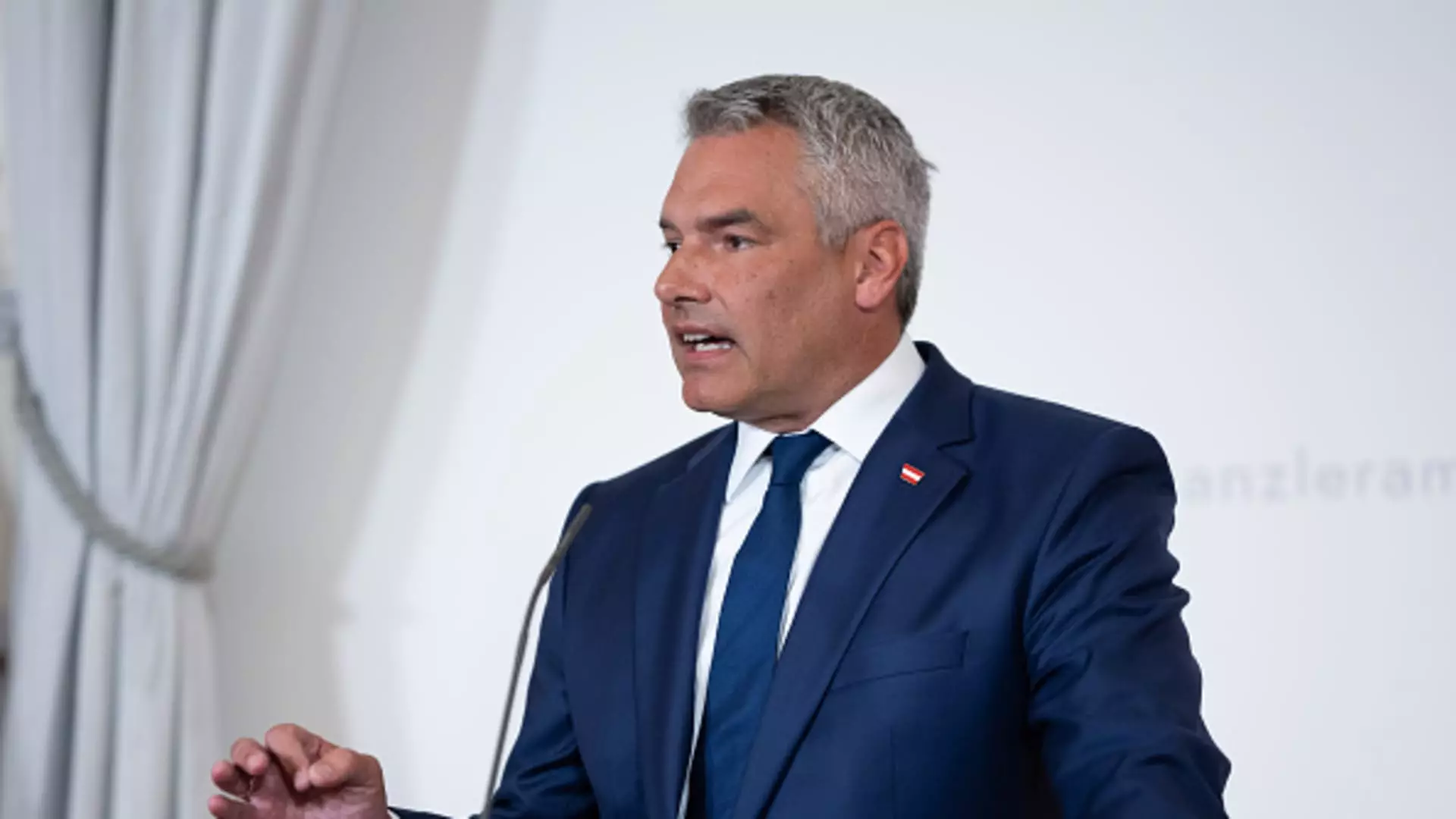
In a dramatic turn of events, the discussions to forge a coalition government in Austria between the two prominent centrist factions have unraveled, sparking significant political ramifications. Chancellor Karl Nehammer made headlines by announcing his imminent resignation from both the chancellorship and his leadership role in the People’s Party (ÖVP). This decision follows the derailing of coalition talks just a day after the liberal Neos party withdrew, criticizing the other participants for their lack of commitment to essential reforms.
Nehammer’s video statement on social media platform X highlighted the urgency of facilitating a smooth transition. With a mere three months having passed since the parliamentary elections held in September, this breakdown not only reflects the challenges Austria faces in establishing a stable government but also mirrors a broader trend seen across several European nations, including Germany and France, all of which are grappling with the political rise of far-right ideologies.
The Freedom Party (FPÖ), a eurosceptic party garnering nearly 29% of the electoral support, stands at the heart of this political crisis. With no viable coalition partners willing to align with them, the FPÖ finds itself isolated. Despite Nehammer’s dismissal of a potential partnership with FPÖ’s leader Herbert Kickl, the reluctance of other parties to collaborate with the far right presents a significant hurdle in forming a coherent government.
Austrian President Alexander Van der Bellen has been tasked with navigating these murky waters. The fallout from Nehammer’s resignation leads to critical questions about the future structure of the government: will Kickl be named to assemble a new administration, or will the country be thrust into a snap election? Nehammer, despite voicing reservations about Kickl’s ability to govern effectively due to his conspiratorial leanings, acknowledged that parts of the FPÖ share common ground on critical issues like immigration policy.
As the leadership of the ÖVP convenes to identify Nehammer’s successor, there are implications that the upcoming candidate might reconsider the party’s stance towards a coalition with the FPÖ. The ÖVP previously ruled alongside the FPÖ from 2017 until 2019, when a scandal led to the dissolution of that partnership. Given that public support for the FPÖ has surged since the last election, the dynamics of any future coalition are complex and fraught with tension.
Social Democrats (SPÖ) leader Andreas Babler echoed concerns regarding the potential implications of a right-wing coalition, arguing vehemently against what he perceives as a threat to Austrian democracy. The unfolding scenario sets the stage for a confrontation of ideologies in which moderate parties must evaluate their positions against the popularity of the far-right sentiment. Furthermore, the SPÖ’s insistence on wealth and inheritance taxation clashes head-on with the ÖVP’s beliefs, indicating stark divisions that remain unresolved.
As the dust begins to settle, the fallout from this failed coalition has paved the way for harsh criticisms among party leaders, with Kickl denouncing the efforts of Nehammer, Babler, and Van der Bellen as part of a grand failure. The political narrative shifts as expectations grow for either a new government formation or the necessity of another election cycle. This rhetoric of blame reflects a deeper strategy of political maneuvering rehearsed repeatedly in the arena, as parties jockey for power amidst an increasingly polarized electorate.
The political tumult faced by Austria highlights a broader European dilemma—how to navigate governance in an age where traditional two-party systems are challenged implacably by the rise of populist movements. If this impasse continues, the future of Australian governance could hinge upon how well these parties can engage effectively with constituents while countering the encroaching influence of far-right factions. As the nation braces for potential outcomes, the overarching sentiment is one of uncertainty amid a rapidly changing political landscape.