
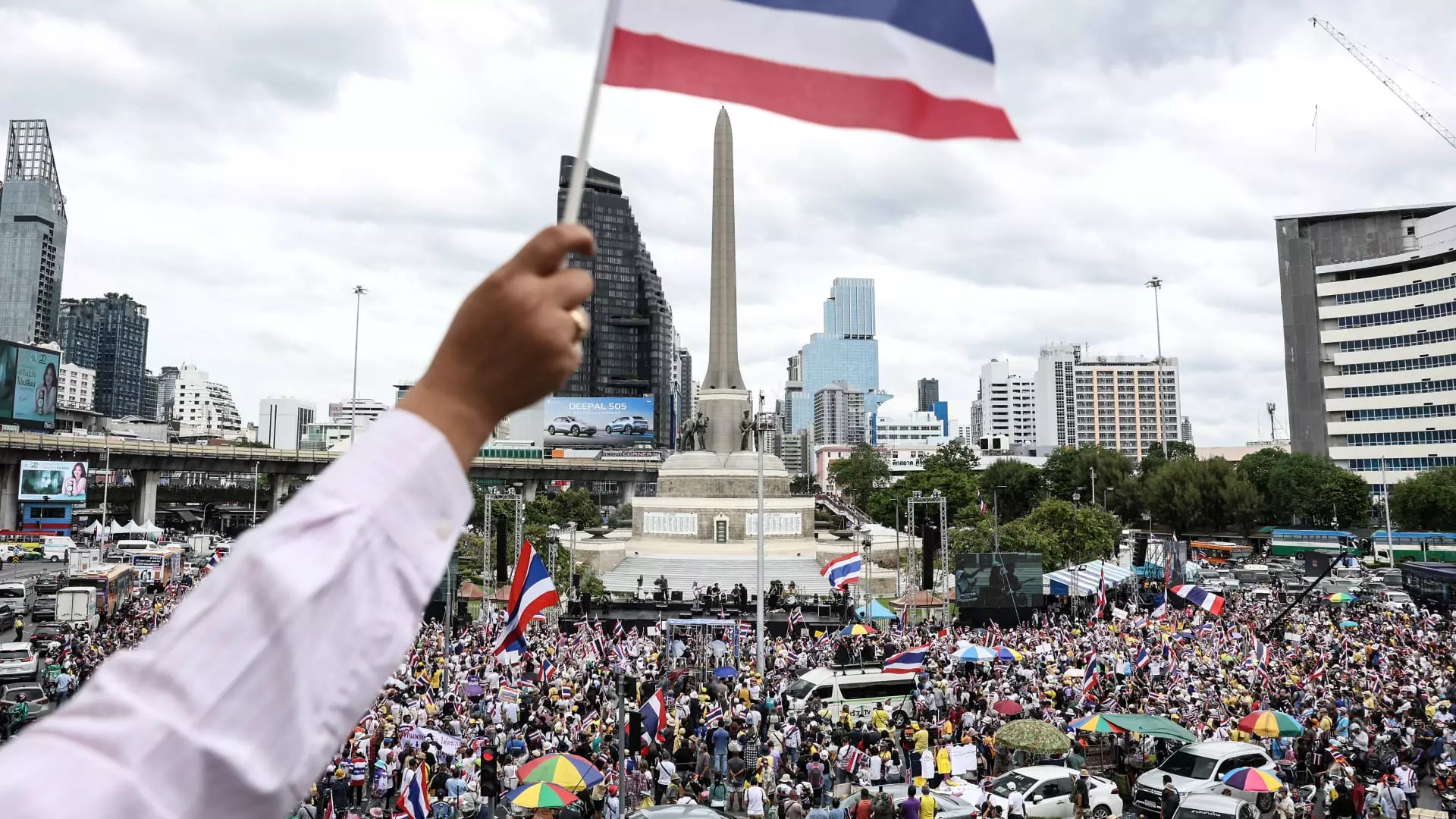
The recent wave of protests in Bangkok signals more than just public dissatisfaction—it reflects a profound crisis of leadership and legitimacy in Thailand’s fragile democracy. Hundreds of demonstrators gathered around the Victory Monument, a potent symbol of sacrifice and national pride, to voice their demand for Prime Minister Paetongtarn Shinawatra’s resignation. This unrest is the most significant since her party took power in 2023, and it exposes how deeply entrenched nationalist sentiments can destabilize governments, especially those associated with the Shinawatra political dynasty, which has long been a contentious force in Thai politics.
The protestors, organized by the United Force of the Land, harness ethnic nationalism and a rigid defense of sovereignty to challenge Paetongtarn’s government. Historically, such grassroots mobilizations have not directly toppled administrations but have been a prelude to judicial interventions or military coups, as seen in 2006 and 2014. These patterns reveal a troubling cycle where popular discontent intertwines with institutional overreach, undermining democratic norms. The military’s shadow looms large over the political arena, and any perceived slight against it becomes a rallying cry for opposition forces.
A Leadership Tested by External and Internal Pressures
Paetongtarn’s precarious position—leading a slim coalition after losing the Bhumjaithai Party’s support—is emblematic of her administration’s vulnerability. The catalyst for this political fracture is a leaked phone call with Cambodia’s former premier Hun Sen, during which she appeared to criticize a revered Thai military commander. In a country where the military’s influence is unmatched, this breach was not just a diplomatic misstep but a political blunder fraught with consequence. The fallout has strained Thai-Cambodian relations and emboldened nationalist factions, feeding into the narrative of governmental weakness and betrayal.
Despite the mounting opposition, Paetongtarn has tried to project an image of composure and openness, emphasizing the right to peaceful protest and refusing to escalate the situation. Yet, these statements do little to mask the high stakes of the moment. Parliamentary dynamics are volatile, and there is a real possibility of a no-confidence vote, further threatening the government’s survival. Moreover, judicial inquiries into the leaked call add an unpredictable legal dimension to her political challenges, underscoring how legal institutions can be weaponized in Thailand’s polarized climate.
The Broader Implications: A Democracy at Risk
This unfolding crisis underscores a collision between liberal governance ambitions and entrenched nationalist fervor that prioritizes sovereignty and traditional power centers like the military. Paetongtarn’s struggle is not simply about a diplomatic gaffe; it represents the difficulty of governing amidst a politically fractured landscape where democratic gains are fragile and constantly tested by populist nationalism and backroom power struggles.
In this volatile environment, the international community and Thai civil society must be vigilant. The danger is that political turmoil will further undermine Thailand’s economic recovery, exacerbating social inequalities that fuel nationalist rhetoric. If democracy is to take deeper root in Thailand, there needs to be a concerted effort to protect institutions from partisan exploitation while addressing the legitimate concerns of a populace wary of foreign influence and internal division.
Paetongtarn’s challenge will be to navigate this minefield with a balance of pragmatism and principle, but the wider political culture must also evolve from confrontation toward genuine democratic engagement—and that is a steep climb in a country haunted by coups and political fragility.