
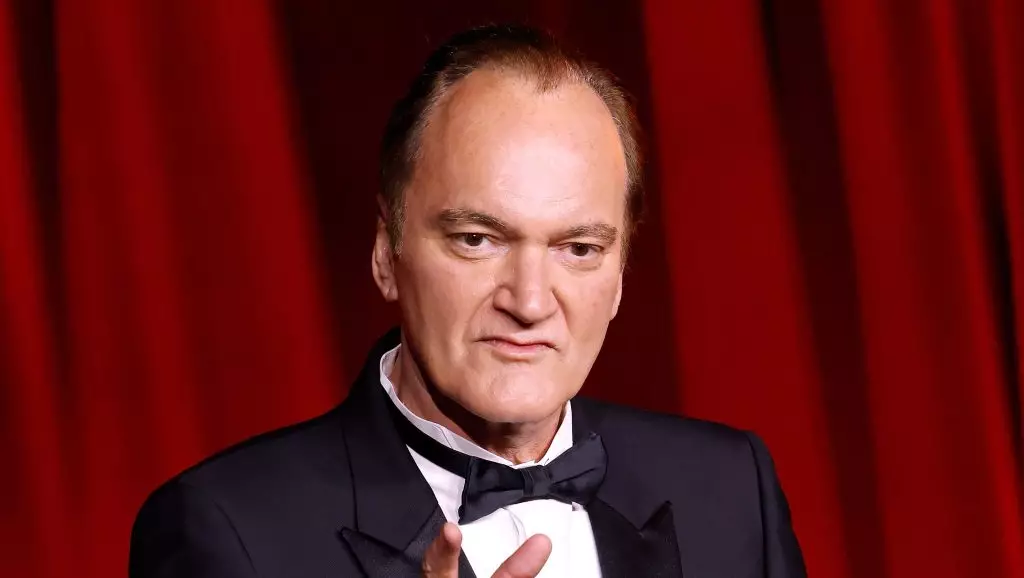
Quentin Tarantino has long championed himself as a rebellious auteur, unafraid to challenge conventions and craft stories that captivate and provoke. His announcement that “The Movie Critic” would serve as his swan song was hailed by fans and critics alike as an exciting culmination of a tumultuous career. Yet, beneath the surface lay a disconcerting truth: Tarantino’s decision to abandon his final project exposes the fragility of artistic ambition when confronted with the realities of filmmaking. It seems that, despite his outward confidence, the legendary director’s creative process was besieged by self-doubt and a lack of genuine enthusiasm. The idea that he was “very happy” with his scripts but quickly lost interest in directing reveals a troubling dissonance—his heartfelt vision being undermined by internal hesitations.
This behavior underscores an alarming pattern where creative giants, despite their confidence, grapple with the vulnerability of their own visions. Tarantino’s retreat from “The Movie Critic” might appear as a personal setback, but it also represents a broader issue within the realm of Hollywood’s auteur landscape: the difficulty in translating compelling ideas into compelling films. When Tarantino admits that he was not “really excited” in pre-production, it signals a crisis of motivation, raising questions about whether the project was ever truly suited to become his final statement or just a contractual obligation cloaked in symbolism. The dissonance between aspiration and reality diminishes the narrative of a legendary filmmaker leaving behind a fitting legacy, instead exposing a human tendency to retreat when faced with the unpredictable, often disillusioning process of filmmaking.
The Myth of the “Perfect” Farewell
The idea of a definitive farewell film has become a Hollywood staple—something that fans cling to as an artist’s last gift to their audience. Tarantino’s initial declaration that “The Movie Critic” would be his final act was a promise of closure, a carefully curated closure that would encapsulate his career philosophy. Unfortunately, this promise now appears hollow. The rejection of “The Movie Critic” isn’t just about a missed project; it symbolizes the challenge of leaving a meaningful artistic imprint when inspiration falters. Tarantino himself admits that he struggled to find excitement in the project once it moved into pre-production, revealing an uncomfortable truth: creative passion can be fleeting, even for those who have built their careers on passion.
What’s troubling here is the broader cultural obsession with “finality.” We are conditioned to seek closure, to believe that the last work of a master should be unequivocally perfect—an iconic reaffirmation of their talent. Tarantino’s decision to step away from his own project demonstrates that such closure might be more myth than reality. It underscores the importance of authenticity over spectacle—the recognition that even legendary artists are susceptible to creative fatigue and internal conflicts. The “perfect” farewell might never materialize, and perhaps that’s a lesson worth embracing: art is an ongoing journey, not a grand finale.
Missed Opportunities and the Risks of Self-Imposed Limits
The reluctance of Tarantino to proceed with “The Movie Critic” also exposes the perils of self-imposed artistic challenges. When Tarantino set out to make a film about the “most boring profession,” he aimed to transform mundane into mesmerizing. That high-minded goal is admirable but ultimately impractical. The confidence that he could make a film about a movie critic captivating speaks to a certain hubris—an assumption that he could reinvent storytelling through a seemingly trivial subject. This ambitious but flawed premise highlights a recurring theme in Tarantino’s work: the tendency to overreach in pursuit of artistic distinction.
Furthermore, his candid admission that he was more excited about writing than directing points to a critical flaw—an inability to sustain enthusiasm through the full creative process. If even Tarantino, with his mastery of storytelling, can falter at the precipice of filming, what does it say about Hollywood’s obsession with perfection? The pressure to produce a “statement piece” for one’s final act can lead talented directors to overcomplicate or second-guess themselves, resulting in missed opportunities. Tarantino’s decision to re-evaluate and potentially craft a different “final” project might be a healthy reminder that greatness sometimes lies in knowing when to abandon a burdensome concept rather than forcing it into existence at all costs.
The Implications for Future Filmmakers
In many ways, Tarantino’s retreat from “The Movie Critic” is a sobering lesson for emerging filmmakers who see their elders as infallible giants. The myth of the flawless auteur’s final masterpiece is just that—a myth. Creativity is unpredictable, and even the most esteemed directors are vulnerable to exhaustion and disillusionment. Tarantino’s honesty about his lack of excitement signals a crucial shift in how audiences and critics should view artistic success: not as the culmination of a perfect career, but as an imperfect, ongoing process.
Rather than clinging to the idea that a director must produce a “great final film,” perhaps the focus should be on honoring the honesty and authenticity of the creative journey. Tarantino’s refusal to continue with “The Movie Critic” demonstrates self-awareness and integrity—traits that any burgeoning artist should emulate. It is a reminder that sometimes, stepping away is more powerful than forcing a work that no longer aligns with one’s passion or vision. As the industry continues to evolve, the importance of embracing vulnerability over perfection will be essential in cultivating a more humane, realistic understanding of creativity and artistic legacy.