
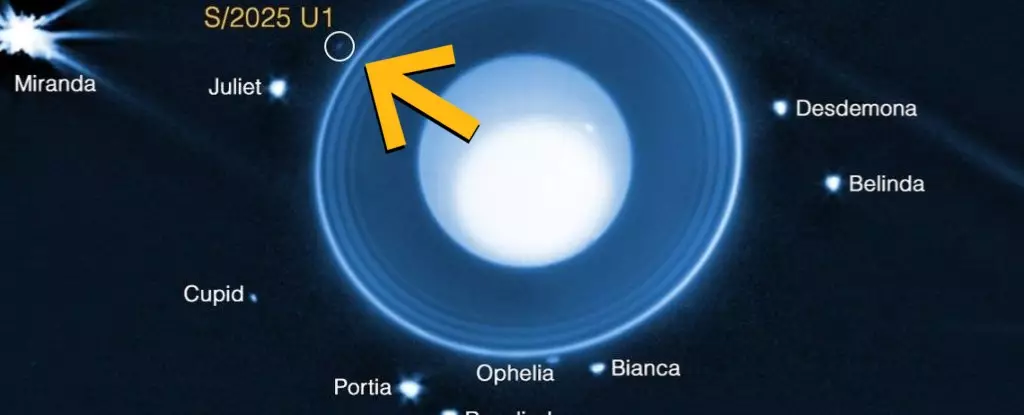
The recent discovery of an obscure moon orbiting Uranus exposes our alarming ignorance about the celestial neighborhood we inhabit. Despite decades of space exploration and technology advancements, our understanding of this icy giant remains grossly incomplete. Finding a tiny, previously undetected satellite—the so-called S/2025 U1—serves as stark evidence of how much remains concealed in the depths of our solar system. It’s a sobering reminder that, even after the pioneering Voyager missions and with the cutting-edge James Webb Space Telescope, we still overlook vast regions of space teeming with secrets. This discovery underscores our collective complacency and the urgent necessity for renewed commitment to planetary exploration. It’s a clarion call to stop underestimating our cosmic ignorance and to prioritize further investigation into these mysterious fronts of our solar system.
An Illusion of Progress in Space Exploration
While many laud the JWST for its breakthroughs, its glimpses into Uranus are but a sliver of what we should strive to understand. The discovery of S/2025 U1—an inconspicuous 10-kilometer fragment—paints a picture of a complex, dynamic Uranian system that defies simplistic explanations. The fact that such a tiny moon could go unnoticed for so long exemplifies our superficial grasp of planetary systems that are potentially as chaotic as they are beautiful. The notion that these moons and rings may be the remnants of violent past interactions is a stark contrast to the sanitized, polished narratives often presented by space agencies. Our oversight reveals not only our technological shortcomings but also a philosophical failure: we treat space as a distant, unchangeable frontier, instead of an evolving, often violent realm that demands our urgent curiosity and respect.
A Call to Action for Humanity’s Cosmic Responsibility
This discovery should ignite a sense of responsibility—not complacency—within the scientific community and society at large. We cannot afford to treat space exploration as a mere prestige battle or a distant hobby; it’s a vital necessity for understanding our place in the universe and safeguarding our future. The persistent pattern of neglect—evident in our slow response and limited budget—puts us at risk of falling behind, missing critical signs of celestial phenomena that could impact Earth. The small moon’s nearly circular orbit suggests it formed in situ, hinting at a primordial history that we are only beginning to piece together. The more we learn about Uranus’s complex moon system, the more it becomes evident that we’ve merely scratched the surface. Society must embrace a paradigm shift—allocating more resources, fostering international collaboration, and cultivating genuine curiosity—rather than simply praising our technological achievements while remaining oblivious to the cosmos’s profound mysteries. In facing these challenges, we define whether we are citizens of Earth or mere spectators in a universe that demands active engagement and responsibility.