
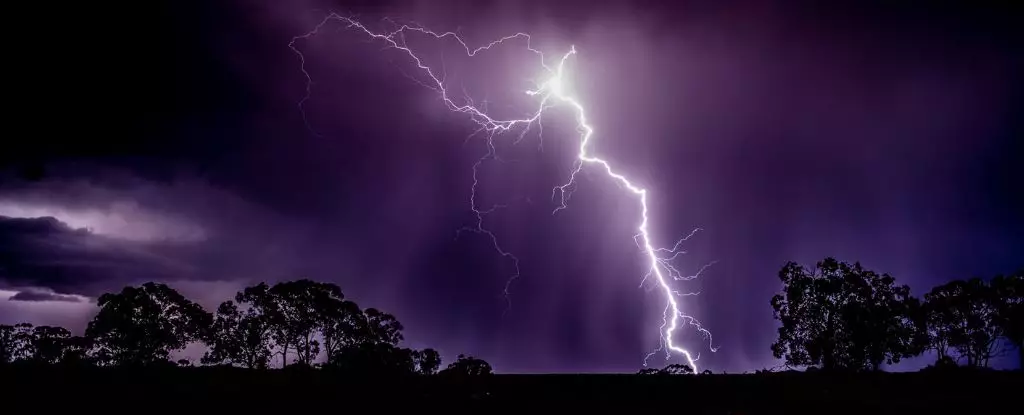
Few phenomena reveal the true brutality of nature more vividly than lightning. It strikes with incendiary fury, often unnoticed in the broader narrative of environmental change. Recent groundbreaking research underscores just how underestimated and underappreciated this force truly is—claiming the lives of hundreds of millions of trees each year. This is not merely about limb loss or canopy damage; it’s about a systematic, invisible culling that chips away at the health and resilience of global forests.
While climate change and deforestation garner widespread attention, lightning remains a surprisingly elusive culprit—its lethal power cloaked behind the brief flash and thunderclap. The stark reality reveals that an estimated 320 million trees perish annually due to lightning strikes alone. This death toll, though seemingly small in the grand scale of natural causes, represents a significant, often overlooked contributor to forest degradation and carbon emissions. It’s an insidious process that sustains a cycle of destruction, often far removed from our everyday consciousness but deeply woven into the fabric of ecosystems.
The Global Toll and Ecological Cost
What makes lightning-induced mortality particularly alarming is the sheer scale of its effects on mature, large trees—those towering giants that serve as the backbone of forest ecosystems. The data suggests that approximately 6.3 percent of big tree deaths can be directly attributed to lightning—a figure that commands respect given the vital ecological roles these giants play. These trees are the keystones of biodiversity, carbon sequestration, and habitat provision; their loss sends ripple effects through ecosystems that are difficult to quantify but profoundly felt.
Furthermore, the horizontal reach of lightning strikes adds an element of contagion, with one strike capable of causing secondary fatalities across nearly 150 feet of neighboring trees. Such “shock waves” of destruction highlight a critical oversight in forest management and scientific modeling—failing to account for these chain reactions, which could amplify the real damage far beyond initial strikes. A lightning strike isn’t a solitary event; it’s a catalyst for communal not-so-benign demise, turning forest health into a fragile, constantly shifting puzzle.
The ecological ramifications extend beyond mere death tolls. The dead trees, especially in significant numbers, release vast amounts of carbon dioxide—over a billion tons annually—further contributing to the greenhouse effect. This process exacerbates climate change, which in turn is predicted to increase lightning activity, creating a vicious feedback loop of destruction and emissions. It’s a complex, dangerous dynamic that fuels skepticism over whether current environmental policies are sufficient to address such multifaceted threats.
The Shadows of Underestimation and Future Risks
What’s perhaps most disturbing about these findings is how underestimated lightning’s role in forest mortality has been historically. Traditional models have failed to capture the full scope, often relying on coarse estimates and infrequent observations. The reliance on advanced mathematical modeling and innovative detection systems has shed new light on this hidden enemy, revealing that lightning accounts for a far larger share of tree deaths than previously thought.
This revelation raises serious concerns about the future trajectory of global forests. Climate change is predicted to intensify lightning activity, especially across higher latitudes and in previously less-affected regions like boreal and temperate forests. An anticipated rise in lightning frequency—up to 20 percent by some estimates—could result in a dramatic increase in large-tree mortality. Such changes threaten to undermine the resilience of forests already strained by human activity and environmental stressors.
In this context, recognizing and integrating lightning-induced mortality into ecological models isn’t just a scientific necessity—it’s an ethical imperative. Policy frameworks, conservation strategies, and climate mitigation efforts must adapt to these new insights. Ignoring this silent killer risks leaving enormous gaps in our understanding of forest health and climate feedbacks. As the clouds gather and lightning strikes become more frequent, our ability to respond effectively will determine the future of forests that still stand as vital carbon sinks and biodiversity hotspots.
In essence, ignoring the threat posed by lightning is akin to neglecting a key piece of the puzzle—one that could spell disaster if left unaddressed. If societies aim for meaningful progress in combating climate change and preserving natural ecosystems, acknowledgment of this invisible yet relentless force is crucial. It’s time we stop overlooking the storm overhead and start understanding its profound implications for our planet’s ecological and atmospheric health.