
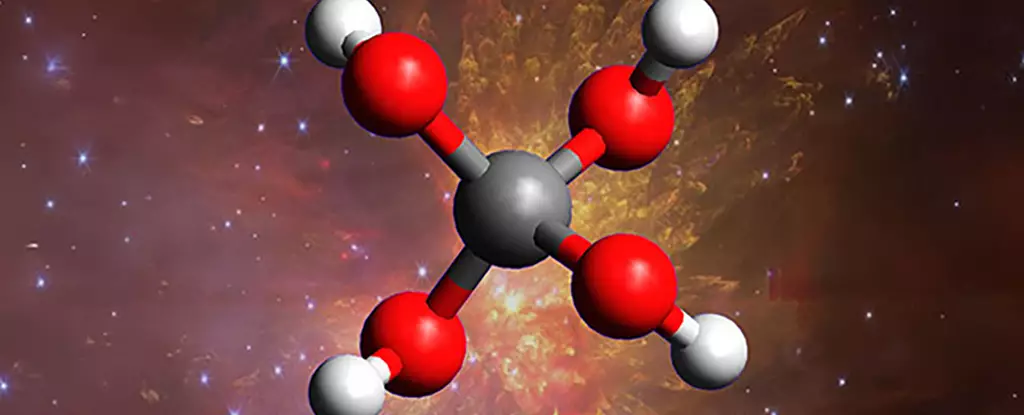
The recent announcement of methanetetrol’s synthesis in laboratory conditions offers a tantalizing glimpse into what might be possible in the depths of space. However, beneath the surface of this groundbreaking claim lies a stark reality: such molecules are inherently unstable, fleeting, and extraordinarily difficult to detect in their natural cosmic environments. Despite the fervor surrounding this discovery, it blurs the line between scientific curiosity and overhyped speculation. The enthusiasm fails to address the fundamental question of whether we can truly confirm its existence beyond lab conditions, or if these are mere ghostly echoes of theories long held but never practically realized.
The experiments recreating interstellar space’s extreme conditions serve as impressive technical feats, yet they also highlight our collective cognitive bias—an innate tendency to fill gaps in understanding with hopeful assumptions. The creation of methanetetrol in a controlled environment may reaffirm scientific models, but it risks overselling the molecule’s relevance in the chaotic, unpredictable cosmos. We must be critical of the narrative that suggests laboratory molecules automatically imply their natural counterparts are out there, quietly shaping the universe’s chemistry. The truth is, the universe remains a far harsher, more transient place, where molecules that appear possible in a lab rapidly dissociate when exposed to light, radiation, or turbulence, making their natural existence exceedingly unlikely.
Questioning the Significance in Cosmic Chemistry and Astrobiology
The excitement about methanetetrol’s potential role in celestial chemistry is understandable but unwarranted by overconfidence. It’s important to recognize that our understanding of space molecules is painfully limited—we’ve identified only a tiny fraction of the chemical complexity around us. The discovery of such a volatile molecule does little to bridge that gap; instead, it accentuates how much remains hidden behind the veil of technical limitations and observational challenges.
Positing that molecules like methanetetrol could influence star formation or the genesis of life remains speculative at best. The notion that discovering “impossible” molecules might lead us closer to understanding extraterrestrial life is appealing but overly optimistic. The reality is that the complexity of life’s origins likely depends on far more stable, Earth-like chemistry, not the fleeting, unstable configurations mimicked under laboratory pressures. The allure of such molecules risks diverting attention and resources away from more promising avenues—such as studying long-lived organic molecules and complex compounds that can endure in space long enough to influence planetary systems.
Furthermore, the current obsession with finding such elusive molecules may foster a misleading view that space chemistry is an ongoing arms race of discovery, rather than a slow, incremental process of piecing together a vast cosmic puzzle. It prompts us to consider whether we are overreacting to isolated laboratory findings, rather than systematically building a realistic understanding of what molecules genuinely impact astrophysics and astrobiology.
The Mirage of Progress and Hype-Driven Science
Promoters of these discoveries often frame them as adding new chapters to our cosmic knowledge. In truth, they frequently serve as “proof of concept” rather than definitive evidence of these molecules’ roles in space. The media hype surrounding methanetetrol’s synthesis creates an exaggerated sense of breakthrough, all while neglecting the enormous observational challenges—most notably its instability and the difficulty of detecting it amid the cosmic noise.
This relentless pursuit of “impossible” molecules risks turning science into a spectacle, rather than a methodical inquiry. The likelihood of directly observing methanetetrol in space—given its rapid dissociation upon exposure to light—is minimal. It might forever remain a laboratory artifact, a chemical curiosity rather than an actual participant in celestial processes. This disconnect underscores the danger of conflating laboratory results with cosmic reality, leading to overly optimistic narratives that may impede more grounded, pragmatic research.
As scientists celebrate the near-miraculous creation of such molecules in a lab, we should question whether these efforts are an end goal or a distraction. Progress in space chemistry demands humility—not an uncritical thrill for the next big discovery. Clear-eyed skepticism is necessary, reminding us that the universe’s mysteries are likely far more subtle—and less glamorous—than our current scientific narratives often suggest.
The Need for a Realistic Approach to Space Exploration
While technological advances in telescopes and analytical tools are undoubtedly impressive, they do not guarantee that transient, unstable molecules like methanetetrol actually exist in space. A pragmatic outlook must acknowledge that the cosmic environment is inherently hostile to such fragile entities. Our current models are still rudimentary, and jumping to conclusions based on fragile lab results does more to inflate our scientific hubris than to advance meaningful understanding.
Innovators in the field should focus on developing detection techniques suited for the harsh realities of space. Instead of chasing “impossible” molecules, perhaps we should prioritize studying more stable organic compounds or phenomena with a higher likelihood of persistence over cosmic timescales. The dream of unraveling the universe’s tiniest, most ephemeral chemicals must be tempered with scientific humility—recognizing that some discoveries, no matter how alluring, may never be verified beyond the confines of a lab.
The ongoing fascination with space chemistry, driven by a mixture of curiosity and the human desire for novelty, risks overshadowing more critical questions: How do complex molecules truly form, survive, and influence planetary systems? What role do enduring organic compounds play in prebiotic chemistry? A balanced, skeptical approach can avoid chasing false hopes while fostering genuine progress rooted in scientific rigor and critical evaluation.