
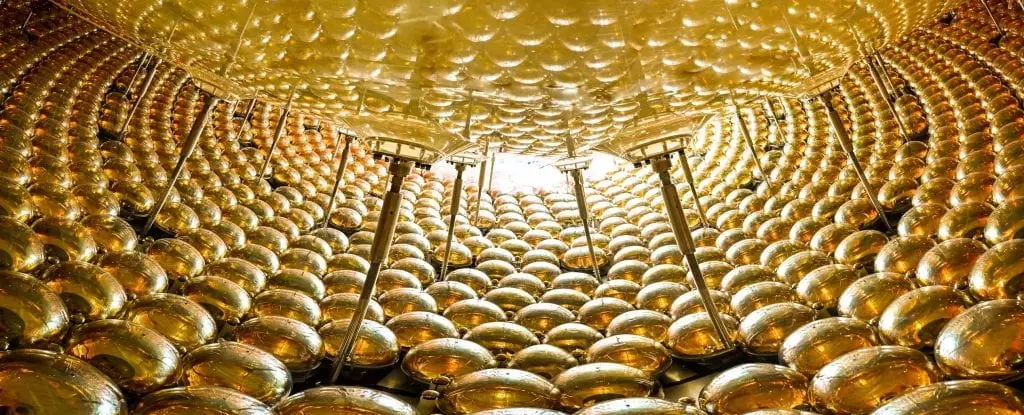
The neutrino, often dubbed the “ghost particle,” embodies the profound limitations of human scientific ability. These subatomic entities have become paradoxical symbols of both the universe’s secrets and our inability to comprehend them fully. Despite their sheer abundance—invisible, silent travelers passing through every living organism—neutrinos remain maddeningly elusive. Our current detection methods, while increasingly sophisticated, still grapple with their faint interactions, a reminder that some truths of nature are intentionally veiled. The newly operational Jiangmen Underground Neutrino Observatory (JUNO) stands as a testament to this ongoing struggle, promising incremental insights but also exposing the persistent barriers to understanding these particles’ true nature.
The Illusion of Progress in a Complex Quest
JUNO’s ambitious design situates it beneath 700 meters of earth, shielding it from many other particles and noise, yet the challenge persists. The project relies heavily on a vast array of photodetectors submerged in a sphere of liquid scintillator—a particle-catching mechanism that hopes to register the feeble flashes of photons emitted when neutrinos interact. Still, the reality is that these interactions are so rare that expecting definitive breakthroughs is, at best, optimistic. The detector operates in an environment saturated with artificial neutrinos from nearby nuclear plants, complicating the task further. Instead of direct discoveries, what JUNO offers is a long-term collection of data with limited statistical significance, a slow, grinding pursuit toward understanding.
The Illusive Hierarchy and Oscillations
Much of the scientific community’s energy is directed toward deciphering the neutrino mass hierarchy—determining which among the three types (electron, muon, tau) is heaviest or lightest. The issues go beyond mere classification; they strike at the core of our understanding of particle physics and cosmology. If neutrinos change their type—a process known as oscillation—then unraveling their oscillation frequency might shed light on fundamental symmetries in nature or even hint at physics beyond the Standard Model. Yet, the very particles under investigation remain cloaked in ambiguity, their properties too subtle to be pinned down with certainty. Every tiny shift, every minute variance, feels more like an approximation than a definitive measurement, highlighting how much of science remains on the edge of uncertainty.
The Broader Implication of the Silence
Exploring neutrinos isn’t merely about understanding an esoteric particle; it is intertwined with some of the universe’s deepest mysteries. They are believed to have played a crucial role in the inflationary epoch of the Big Bang, influence the formation of galaxies, and even shed light on processes happening deep within Earth’s crust. Still, these insights are hampered by the particles’ incredible transparency. The hope that JUNO might finally distinguish between the masses or reveal the frequency of oscillation sounds more like a tantalizing aspiration than a guaranteed discovery—an optimistic leap over the abyss of scientific uncertainty. While the collaborative effort of dozens of institutions signifies collective perseverance, it cannot mask the sobering reality that some secrets may remain forever beyond our grasp, or only discernible through means we have yet to conceive.
The Reality of Scientific Limitation and the Need for Humility
In essence, the pursuit of neutrino knowledge underscores a fundamental truth about science: progress is painstaking and often limited. For all our technological advancement, the universe retains a stubborn capacity to withhold its deepest secrets. Sometimes, the most valuable insight is recognizing when the questions exceed our current ability to find answers. The path to understanding neutrinos reflects a broader philosophical stance—the importance of humility in scientific inquiry. Not every mystery yields easily, and not every experiment guarantees a breakthrough. Yet, in embracing these limitations, scientists reaffirm their commitment to patience, incremental progress, and the acceptance that truth sometimes remains just out of reach, waiting for a future light that may or may not come.