
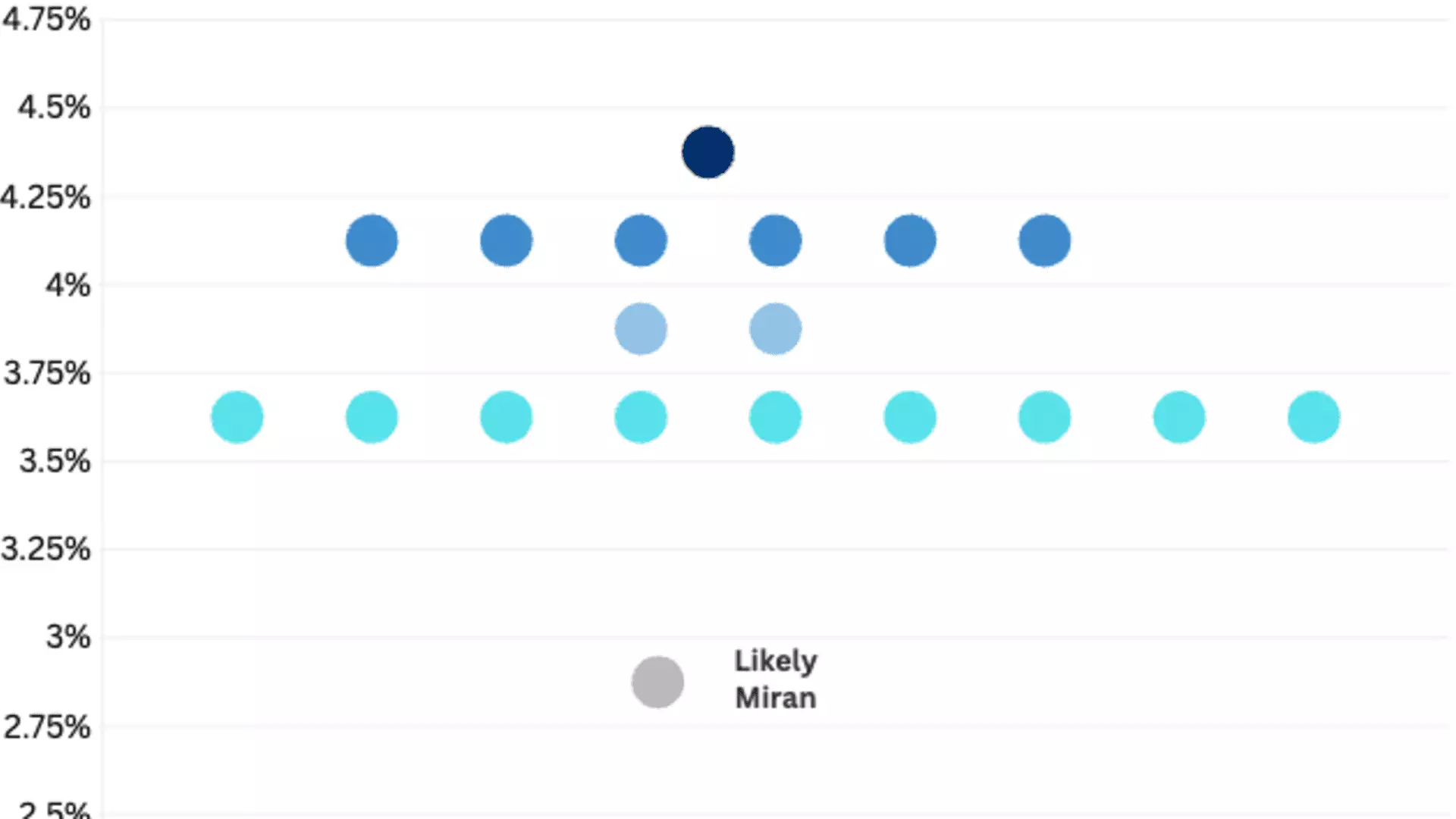
In a landscape often characterized by cautious consensus, Fed Governor Stephen Miran’s dissent stands out as a breath of unexpected boldness. While the Federal Reserve’s decision to cut interest rates by a modest quarter point might suggest a careful balancing act designed to sustain economic growth without overheating, Miran’s push for a much deeper, half-point cut reveals a stark divergence from the established narrative. This isn’t just a technical disagreement; it’s a serious challenge to the perceived unity of the central bank, hinting at underlying tensions that threaten to destabilize the Fed’s credibility.
What makes Miran’s position so striking is not merely the size of his proposed cut but his confidence in advocating a more aggressive monetary easing. He appears to view current economic signals as underscoring urgent problems—perhaps signs of fragility in the recovery, brewing inflationary pressures, or external shocks—yet the rest of the Committee remains hesitant. His stance isn’t just an isolated voice but echoes an emerging center of thought that questions whether the current approach is sufficiently proactive or whether it’s risking a perilous delay in providing relief to vulnerable sectors.
Miran’s dissent goes beyond the technical; it embodies a philosophical debate about the role of monetary policy in safeguarding economic stability during turbulent times. In advocating for a more dovish stance, he challenges the prevailing consensus that favors cautious, incremental adjustments. This raises a fundamental question: Is the Fed overly committed to cautiousness at the expense of effective action? Or does this apparent division reveal a deeper conflict about the direction of economic policy in a complex, unpredictable global environment?
The Political Undercurrent and the Implications of Power Dynamics
Miran’s recent appointment as a Fed Governor, backed by a President known for outspoken influence over economic policy, adds an extra layer of intrigue. His previous role as Chair of the White House’s Council of Economic Advisors and his explicit alignment with President Trump’s calls for significantly lower rates suggest a political motive that complicates his independence. While the Federal Reserve has long prided itself on insulated decision-making, Miran’s position appears to blur those lines, raising concern among centrist and liberal voices that the Fed remains vulnerable to political interference.
The ideological clash also manifests in the divergence over future rate cuts. Miran’s vision for more aggressive easing, particularly his support for lowering rates far beyond what most of his peers see as prudent, exposes a willingness to prioritize immediate economic stimulus over longer-term inflation control or financial stability. This stance, if adopted widely, could set a dangerous precedent: monetary policy increasingly driven by political ends rather than sound economic principles. The risk is that central bank independence—a cornerstone of effective governance—is being eroded in favor of short-term political signals, undermining trust in the institution.
Moreover, the internal discord within the Committee underscores an instability that might ripple through markets and public confidence. The wide disagreement depicted by the “dots” forecast, with some members envisioning as many as four rate cuts in 2026, exposes a committee grappling with uncertainty and perhaps ideological splits. This internal division, compounded by external political pressures, threatens to undermine the Fed’s credibility at a critical juncture when its independence and integrity are vital for navigating economic turbulence.
Why This Matters for the Center-Left and Responsible Economic Policy
From a center-wing liberal perspective, Miran’s dissent could be viewed as a catalyst for necessary debate, or conversely, as a reckless gamble that could destabilize the fragile economic recovery. While the instinct to push for more aggressive action might resonate with those worried about stagnation or inequality, it also runs the risk of igniting inflation that hits working and middle-class families hardest. The danger lies in allowing political considerations—amplified by the pressure from a partisan administration—to steer monetary policy away from what’s economically prudent and toward an ideological agenda.
This scenario underscores the importance of a balanced approach. It’s crucial that the Fed retains its independence and resists the siren call of populist demands for swift, sweeping rate reductions. Economic policymakers must prioritize stability, long-term growth, and the welfare of all citizens, not just short-term political victories or the interests of powerful financiers. The fight over interest rates becomes a proxy for the broader contest between responsible governance and political expediency.
Miran’s dissent should serve as a wake-up call: the Fed must reaffirm its commitment to independent, data-driven decision-making. Economic health depends not on ideological extremes but on nuanced, balanced policies that recognize the complexity of the modern global economy. Failing to do so risks not only undermining the Fed’s credibility but also fueling populist frustrations that threaten democratic accountability and economic stability in the long run.