
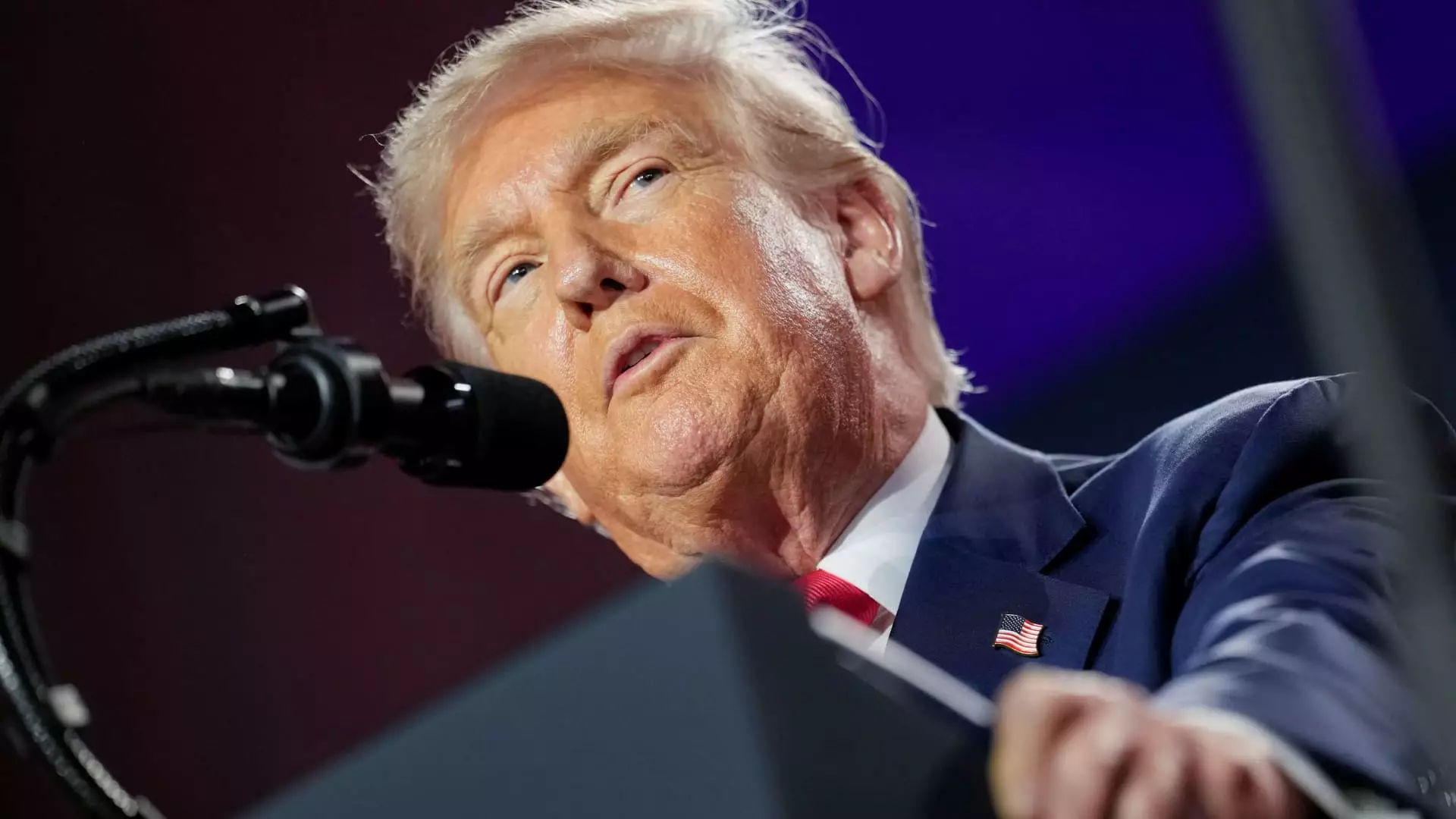
The recent spectacle of President Donald Trump storming the Federal Reserve’s headquarters is a stark reminder of how spectacle often overshadows genuine policymaking. Instead of engaging in meaningful dialogue or proposing constructive reforms, Trump chose to turn a routine institutional visit into a political stunt rooted in personal vendettas. His theatrics, complete with claims of billion-dollar renovations and accusations of mismanagement, serve more to distract than to contribute to the complex realities of monetary policy. This is not leadership; it’s performative posturing that diminishes the integrity of national institutions and undermines the independence of the Federal Reserve.
Rather than fostering a climate of trust and stability, Trump’s aggressive confrontation of Jerome Powell exposes a deeper malaise—an administration eager to manipulate institutions to suit political convenience. His depiction of Fed renovations as “budget-busting” distractions reduces a multifaceted infrastructure project to a scapegoat for broader economic anxieties. This kind of superficial framing perpetuates misinformation, fostering a narrative that the Fed is rogue or irresponsible, when in fact it operates with a degree of independence enshrined by law. The President’s open hostility toward the Fed’s leadership reveals an unsettling desire for control, risking the delicate balance required for effective monetary policy.
An Attack on Monetary Stability and Institutional Integrity
Trump’s relentless pressure on Powell to cut interest rates or risk termination exposes an alarming conflation of political expediency with economic stewardship. The pursuit of near-term political gains—namely, maintaining low interest rates to boost short-term economic performance—risks long-term stability. The Federal Reserve’s independence is a safeguard for sound monetary policy, insulating the economy from rash political influence. Trump’s overt threats and personal insults weaken that safeguard, fostering an environment where monetary decisions are driven less by economic fundamentals and more by political noise.
Moreover, the push to replace Powell with Treasury Secretary Scott Bessent, who is viewed as a political appointee rather than a seasoned central banker, signals a dangerous blurring of autonomous policy-making. It is a reckless gamble on politicking over expertise, with implications that extend beyond the current administration. The central bank’s institutional independence is a cornerstone of economic health; undermining it in favor of short-term political leverage jeopardizes public trust and the credibility of the economy’s most critical institutions.
Rhetoric Instead of Rational Governance
Trump’s campaign against Powell reflects a troubling pattern—an inclination to view economic policy as a battleground for personal and political conquest. Labeling Powell as “grossly mismanaged” without presenting a compelling alternative or understanding the broader context demonstrates unseriousness in leadership. While political leaders have a right to critique and influence policy, their approach should be rooted in fact-based discourse and mutual respect. Unfortunately, Trump’s approach is rooted in vitriol and impulsiveness, eroding the norms that safeguard stable governance.
The timing of this highly publicized Fed visit—an unprecedented event since FDR—raises questions about the integrity of the institution. This spectacle, amid allegations of improper handling of sensitive files, creates an atmosphere of suspicion and instability. Rather than focusing on the country’s economic health, the administration appears more preoccupied with personal vendettas and political survival. This myopic focus is dangerous; it distracts from the real issues—rising debt, inflationary pressures, and the need for thoughtful, independent monetary policies.
The Threat to Democratic Norms and the Rule of Law
What makes Trump’s actions particularly concerning is their potential to chip away at the fundamental principles of governance—namely, the independence of the Federal Reserve and the rule of law. By publicly pressuring a central bank chairman, Trump skirts the boundaries of constitutional norms, threatening to politicize an institution that is vital for economic stability. The recent Supreme Court rulings confirming Fed independence should have provided reassurance; instead, Trump’s actions threaten to erode that safeguard.
The danger lies not just in the immediate threat to Powell’s tenure but in the precedent such behavior sets. A president publicly undermining an independent institution for political advantage risks normalizing interference that could persist long after Trump’s tenure. It exemplifies a troubling shift toward politicized economic policymaking—an approach that can destabilize markets, weaken investor confidence, and ultimately harm the livelihoods of ordinary Americans.
Despite the chaos, it’s worth noting that the core issue remains: the need for credible, independent institutions capable of maintaining economic stability amid political turbulence. Trump’s raid on the Fed’s integrity reflects a broader tendency to view governance as a weapon in partisan conflicts, rather than a framework built on expertise, stability, and accountability.