
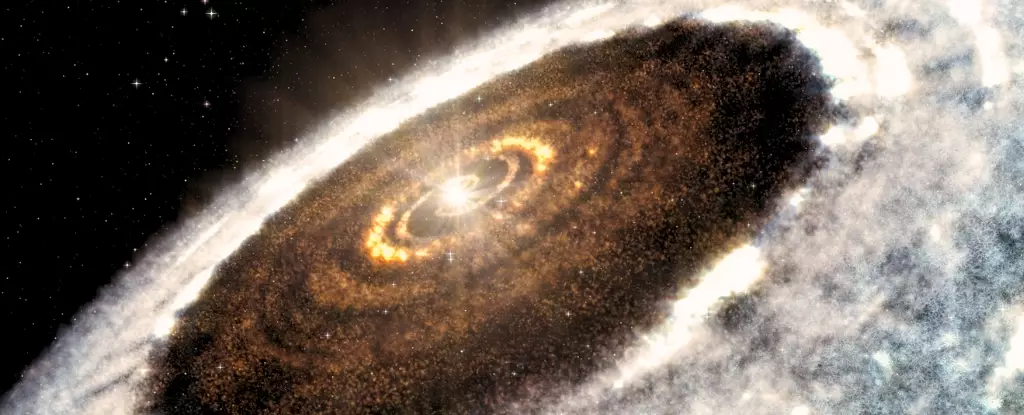
In the vast, cold reaches of space, a narrative of possibility is quietly unfolding—one that challenges the conventional boundaries of our understanding about where life’s building blocks originate. Recent discoveries suggest that molecules fundamental to life, such as amino acid precursors and sugars, are forming much earlier in the universe’s timeline than previously thought. This revelation could rewrite the story of our existence, positioning the birth of life not strictly on fertile planets but potentially deep within the raw chemistry of the universe itself. Yet, beneath this tantalizing prospect lies a sobering reality: many of these molecules are yet to be conclusively verified, and the road to understanding remains perilously uncertain.
The detection of complex organic molecules in the fragile environment surrounding young stars indicates an inheritance of molecular complexity that predates planet formation. Laboratories and telescopes have revealed tantalizing signs that the universe is capable of assembling the fundamental “ingredients” of life much earlier than we had dared imagine. However, this ship of hope stumbles upon a dangerous question: how much of this potential is viable, and how much is merely cosmic debris destined to disintegrate amidst violent stellar outbursts? The delicate dance of molecules within these nascent stellar disks often faces destruction from intense radiation and flare activity, underscoring how fragile and transient these prebiotic ingredients might be.
We are driven by a profound desire to pin down the origins of life, but science often delivers ambiguous signals. The detection of molecules like glycolonitrile—linked to amino acids—raises hope, yet the evidence remains tentative, hanging by a thin thread of observational bias and technological limits. If these molecules are indeed inherited from the cold molecular clouds, as some studies suggest, it implies that the universe may be more generously endowed with the means for life than previously assumed. But the cold truth remains: our capacity to observe, confirm, and understand these molecules is hamstrung by current technology. The small signals uncovered so far are akin to whispered secrets in an overwhelmingly noisy universe, leaving us in a state of cautious skepticism rather than confident conviction.
The Cosmic Factory or a Mythical Mirage?
The story of stellar and planetary formation is one of chaos and destruction, not nurturing. New stars emerge out of collapsing gas clouds, violently expelled and fragmented by stellar winds and intense radiation. Under these tumultuous conditions, the survival of complex molecules seems unlikely; they are thought to be destroyed or rendered inert long before they can seed planets with the ingredients for life. This scientific paradox raises a fundamental question: can molecules that form in the cold and dark accretion disks of stars truly survive the fiery gauntlet of stellar birth? Is the universe merely acting as a cosmic fool’s errand, assembling potential life precursors only to obliterate them in the process?
The discovery around protostar V883 Orionis acts as a faint warning. The presence of bio-relevant molecules amid the chaos demonstrates that, even in the most violent early stages of star development, pathways for complexity are possible. Still, the path from molecules forming on icy grains to becoming part of living organisms is far from assured. The observation that these molecules are likely formed in icy mantles, then released as heat sublimates the ice, speaks to a fragile process highly dependent on conditions beyond our current mastery. To assert that life’s building blocks are naturally handed down from interstellar space to future planets borders on optimism—an optimism that must be tempered with scientific humility.
Current technological limitations cast a shadow over our aspirations. The limited signals obtained through instruments like ALMA, while promising, do not constitute definitive proof. Instead, they are a starting point—impressions left in the cosmic dust that require further, more precise investigation. The caution urged by researchers to look at other wavelengths to confirm and expand these findings underscores a sobering reality: our picture of the universe’s chemistry is still incomplete. This ongoing uncertainty reminds us of the steep, uncertain path that lies ahead before we can confidently claim the universe is teeming with the raw materials of life, waiting like hidden treasures beneath layers of cosmic debris.
The Question of Cosmic Intent and Human Responsibility
This frontier of discovery prompts an unsettling reflection: are we perhaps overselling the universe’s generosity? The narrative of universal life-building potential often echoes with a sense of destiny and inevitability, but the truth is far murkier. The universe might not be an architect of life but rather a chaotic workshop where building blocks come together momentarily before disintegrating into nothingness. The mere presence of complex molecules in star-forming regions does not guarantee that life will emerge; it only suggests that the universe has the capacity, at least temporarily, to produce the ingredients.
As scientists and global citizens, we need to approach these findings with a critical awareness of their limitations. The tendency to interpret tentative data as signs of cosmic inevitability risks fostering complacency or unwarranted optimism. Instead, it should inspire a cautious environmental ethic—acknowledging that whether or not the universe is predisposed to produce life, human stewardship over our planet’s delicate ecosystems remains paramount. Our own existence appears to be a fortunate, fragile anomaly in this grand universe, and assuming cosmic preconditions for life is not a license to neglect our terrestrial responsibilities.
This discovery landscape reveals a universe that might be more attentive to the possibilities of life than we have dared to imagine, but it also invites us to remain grounded. Advances in technology, as promising as they are, do not guarantee answers—only pathways to more questions. When we interpret cosmic signals, let us do so not with naive optimism but with sober scrutiny, recognizing that the universe’s kindness may be conditional, fleeting, or perhaps even accidental. The story of life’s cosmic origins is far from settled, and until we confront its uncertainties head-on, our understanding remains unfulfilled and our hopes unconfirmed.